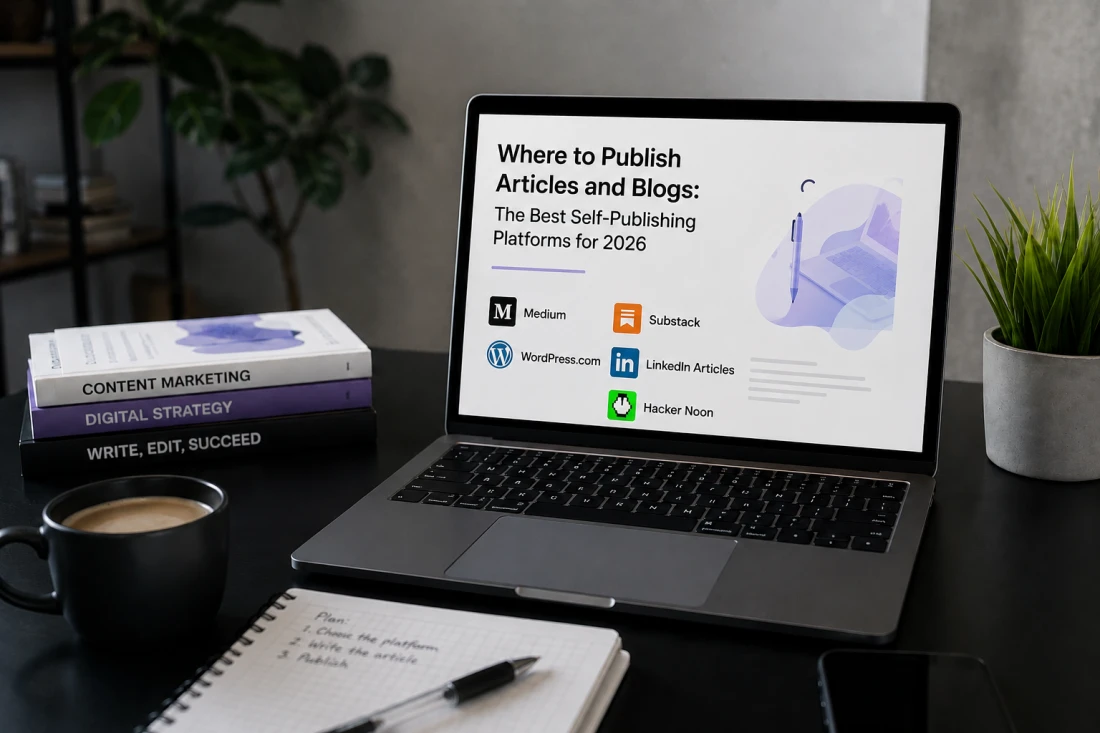
"Which platform has the most traffic" is the wrong first question. Every major self-publishing platform in 2026 runs on its own distribution logic. Some reward dwell time. Some reward your position in a community graph. A few barely distribute anything outside your existing followers. Get the match wrong and a genuinely good piece dies in an empty feed. Get it right and one article keeps pulling in readers, leads, or subscribers for years. Here's what actually matters when picking a home for English-language writing right now.
Introduction
Why publish on external platforms
A brand-new blog on its own domain starts with nothing — no distribution, no authority, and months of SEO work standing between it and its first real audience. External platforms skip that wait. They plug a piece of writing straight into readers who are already there: a recommendation feed, a topic page, a subscriber base built over years. Medium and Substack alone reach tens of millions of active readers, a number no new domain will see on day one, or in year one for that matter.
There's also a credibility angle. A solid piece on Hacker Noon or a genuinely useful Quora answer reads as social proof in a way a company blog post rarely does — readers already trust the platform, so some of that trust rubs off. And several of these sites carry enough domain authority that a single article can rank in Google search results before a brand-new site would even get crawled properly.
What counts as a self-publishing platform
This guide sticks to platforms where anyone can create an account and hit publish without going through a traditional pitch-and-approval cycle: Medium, Substack, WordPress.com, LinkedIn Articles, Hacker Noon, Dev.to, Hashnode, Quora, Reddit, Vocal Media, HubPages, and Blogger. A couple of these — Hacker Noon in particular — layer editorial review on top, but the core publishing action is still self-serve.
How we selected the platforms
Three things had to be true for a platform to make this list: an active English-speaking audience, a real distribution mechanism rather than just a static page that sits there, and rules clear enough that a new writer can actually learn how visibility works. Sites that have quietly turned into closed corporate newsrooms didn't make the cut, and neither did platforms whose English audience has shrunk down to a niche.
How distribution works
What determines visibility
Almost nothing on these platforms gets shown to everyone at once. Most run a two-stage rollout: a piece goes first to a small slice of the audience — followers, a topic feed, an internal test group — and how that group reacts decides whether it goes further. Medium's curation team works this way: humans review stories and sort them into Boost, General, or Network Distribution based on how they perform and who they'd interest. LinkedIn does something similar but on a much tighter clock — the first sixty minutes after posting largely decide whether a post ever reaches second- and third-degree connections.
How ranking and recommendations are built
Substack's growth engine looks different from Medium's. Its Recommendations feature and Notes feed now drive roughly half of all new subscriptions on the platform and a quarter of new paid ones, which means growth increasingly comes down to whether other writers recommend you — not whether Google or Twitter sends traffic your way. LinkedIn's 2026 ranking system, meanwhile, weighs engagement quality in that first hour, then dwell time, then the poster's track record before deciding how far a post travels.
What helps a post gain traction
The same handful of signals keep showing up everywhere: real engagement in the first hours (comments and saves, not just clicks), content that keeps people on the platform instead of sending them elsewhere, and showing up consistently rather than posting once and disappearing. LinkedIn now cuts reach by roughly 60% for posts that link off-platform. Substack rewards writers who publish and engage often enough to build something recognizable — a "signature," in the platform's own language — within their niche.
Platform profiles
Medium
Still the biggest general-interest, algorithmically curated home for long-form writing, with a monthly readership reportedly well past a hundred million. The Partner Program pays based on how long members actually read, not raw pageviews, and in 2026 Medium leaned hard into human curation as its main line of defense against AI-generated filler. The platform's editor-in-chief has said openly that writers posting undisclosed AI content are increasingly demoted or pulled entirely. Getting distributed now has less to do with keyword tricks than with catching a curator's attention or landing inside a well-followed publication.
Substack
What started as a simple newsletter tool has turned into a full publishing ecosystem: email, a blog, and a social layer called Notes, all under one roof. Early 2026 numbers put the platform at over 50 million active subscriptions, more than 5 million of them paid. The real structural advantage is the Recommendation Network — subscribe to one newsletter and Substack immediately prompts you toward others, which more or less solved the cold-start problem that used to strangle new newsletter writers before 2022. The cost of that network effect is a 10% platform fee on paid subscriptions, plus a real dependence on Substack's internal graph for anyone hoping to be discovered.
LinkedIn Articles
LinkedIn Articles live inside a professional network rather than a standalone content site, which makes them a natural fit for thought leadership tied to a personal or company brand — and a poor fit for much else. The 2026 algorithm update pushed hard toward "knowledge and advice" content: an analysis of more than 10,000 posts from early in the year found educational posts pulling three to five times the reach of personal updates or anything promotional. Anything linking out to an external site gets throttled, so LinkedIn works better as a place to deliver standalone value than as a funnel back to your own site.
WordPress.com and Blogger
These are self-publishing platforms in the older, more literal sense of the phrase — hosted blogging tools, not content networks with a recommendation feed baked in. WordPress.com still runs a meaningful share of the web's blogs and gives writers a real domain they actually own, with full control over SEO — the trade-off being that you're building an audience from zero, with no algorithmic boost to lean on. Blogger, Google's long-running tool, has a smaller crowd today but stays free and low-friction for anyone who just wants a simple hosted blog without a platform's algorithm deciding who sees it.
HubPages and Vocal Media
HubPages runs on themed "Hubs" and pays contributors from the ad revenue their articles generate — closer to a content-and-ad-revenue business than a social platform. Vocal Media works on a similar principle: writers post into topic communities, from tech to personal essay, and earn through a mix of platform payouts and reader tips, with occasional paid writing challenges thrown in for extra visibility and prize money. Both sit below Medium in scale but ask far less of a writer trying to earn something steady without chasing curation.
Dev.to and Hashnode
The two big developer-focused blogging platforms take almost opposite approaches. Dev.to has the larger built-in community and puts new writers directly into a live feed that developers actually read, which makes it the faster route to visibility. Hashnode goes the other way — it gives you a blog on your own custom domain with full Markdown control, so the SEO value stays with you instead of feeding Hashnode's authority. The common workaround developers landed on: publish on Hashnode for the SEO, cross-post to Dev.to with a canonical link pointing home, and get both the community reach and the long-term search value.
Hacker Noon
Somewhere between an independent newsroom and a curated tech publication. Unlike Dev.to's open feed, Hacker Noon's editors read submissions and only publish what they consider genuinely strong — which means slower turnaround and a real chance of rejection, but a piece that gets through reaches an established tech readership carrying more built-in credibility than an open community post ever will.
Quora and Reddit
Neither of these is a publishing platform in the usual sense — there's no single "article" format that gets pushed out algorithmically the way a Medium story does. Visibility here comes from answering questions well (Quora) or showing up consistently in a specific community (Reddit) rather than treating either site as a billboard. Quora's Spaces feature lets writers group answers into a themed publication and monetize through subscriptions; most active Spaces reportedly land somewhere between $500 and $2,000 a month after six to twelve months of steady posting. Reddit runs on an unwritten but widely enforced standard known as the 90/10 rule — roughly 90% of what you post should be genuine participation, no more than 10% self-promotional, and moderators judge that ratio against your whole account history, not any single post.
Platform-specific promotion
Content formats that work best
Long-form, evidence-backed writing wins on Medium, Hashnode, and Hacker Noon — pieces built around a clear takeaway, named tools, and specifics readers can check tend to beat vague overviews every time. LinkedIn and Dev.to reward the opposite instinct: shorter, scannable formats. LinkedIn's own 2026 data shows document carousels and polls significantly outperforming plain text. On Quora and Reddit, what wins is a direct, specific, personally-voiced answer to an actual question — not a blog post someone tried to repackage.
Engagement signals that matter
Dwell time and reading time now outrank raw pageviews on most of these platforms. Medium pays through reading time, not clicks. LinkedIn's Depth Score weighs dwell time, comment depth, saves, and private shares well above surface-level reactions like a quick like. On Substack, the strongest signal of all is a subscriber who arrived through another writer's recommendation — those readers convert to paid subscriptions at noticeably better rates than someone who just stumbled in.
Common mistakes that suppress reach
The most common one: treating every platform the same. Posting a link-heavy, promotional piece written for a company blog straight onto LinkedIn, Reddit, or Medium almost guarantees it gets buried. LinkedIn now cuts reach by roughly 60% for posts carrying an external link. Reddit communities remove or quietly mute anything that reads as an ad instead of a genuine contribution. Medium's curators specifically flag stories built on undisclosed AI-generated filler and demote them.
Manipulation and enforcement
Typical manipulation tactics
The playbook repeats across platforms: buying or trading fake engagement — claps, upvotes, comments — running multiple accounts to fake organic interest, dressing up paid or affiliate content as personal opinion, and linking the same external site over and over without adding anything new. Reddit has its own name for one version of this — "sock puppeting," using secondary accounts to upvote or comment on your own posts — along with posting identical promotional content across unrelated subreddits.
How platforms detect abuse
The detection methods differ, but the underlying question is always the same: does this look like organic behavior or not? Reddit's moderators and automated systems watch for accounts whose history is dominated by links to a single outside site — that pattern reads as a broadcast channel, not a community member. LinkedIn's 2026 algorithm specifically targets coordinated engagement: reciprocal patterns from engagement pods get flagged and shadowbanned by its AI systems, with no warning issued beforehand. Medium's curators don't run automated fact-checks, but reviewing flagged stories for undisclosed AI content and other policy violations is a routine part of how curation works now.
Penalties and account restrictions
Punishment tends to escalate in stages rather than jumping straight to a ban. On Reddit, the typical progression runs from a single post getting removed, to a permanent ban from that one subreddit, to a site-wide shadowban where posts become invisible to everyone but the poster, and finally — for the worst offenders — full account suspension. Medium's version is quieter: a story can simply get excluded from Boost or General Distribution while staying live on the writer's own profile, capping its reach without anyone announcing a penalty. LinkedIn works the same way with engagement-pod behavior — the account isn't banned outright, its content just stops showing up beyond a shrinking circle of connections.
How to choose a platform
Best options for business content
LinkedIn Articles and Medium's business-focused publications are the strongest fit for B2B thought leadership, since both put content directly in front of professional, decision-maker audiences. Add Substack if the goal is a long-term, owned relationship with a business audience — a newsletter builds that in a way a one-off article can't.
Best options for IT and SaaS
Dev.to and Hashnode are the obvious defaults for developer-facing technical writing, with Hacker Noon a strong option when the piece leans more narrative or thought-leadership and less code. For SaaS companies specifically, publishing a canonical piece on the owned blog first and cross-posting to Dev.to or Hashnode has become the standard move — community reach without giving up the SEO.
Best options for expert and educational content
Medium and Quora both reward demonstrated expertise, just through different mechanics: Medium through curation and Partner Program payouts on substantive long-form work, Quora through consistent, specific answers that build a reputation in a niche over time. Vocal Media and HubPages are the lower-effort alternative for experts who'd rather publish steadily than chase curators.
Best options for SEO and long-tail traffic
Hashnode and WordPress.com hold onto the most SEO value, since both let writers publish on a domain they control instead of a shared platform URL. Anywhere a custom domain isn't an option, canonical tags do the same job when cross-posting — publish on the owned blog, syndicate to Dev.to with a canonical pointing back, and keep the search equity where it belongs.
Final recommendations
Best platforms to start with
For most writers or brands new to self-publishing, a sensible starting pair is one broad-reach platform — Medium or LinkedIn Articles, depending on whether the target is a general audience or a professional network — and one niche platform matched to the actual topic: Dev.to or Hashnode for technical writing, Quora for anything expertise-driven.
Best platforms for maximum reach
Substack and Medium currently offer the highest realistic ceiling for organic reach in English-language publishing, thanks to their recommendation systems, with Reddit close behind for topic-specific virality — but only when a post genuinely fits what a community cares about, not when it reads as an ad wearing a community's language.
Best platforms for authority building
Hacker Noon and Hashnode build authority two different ways — editorial selectivity on one side, ownership on the other. Getting accepted by Hacker Noon's editors, or keeping a consistent, well-linked blog going on Hashnode, signals credibility in a way a single viral post never quite manages. Quora Spaces and LinkedIn Articles do the same job for individual experts building a personal brand over time: what compounds into authority on either platform is consistency, not a lucky hit.

Internet Marketer