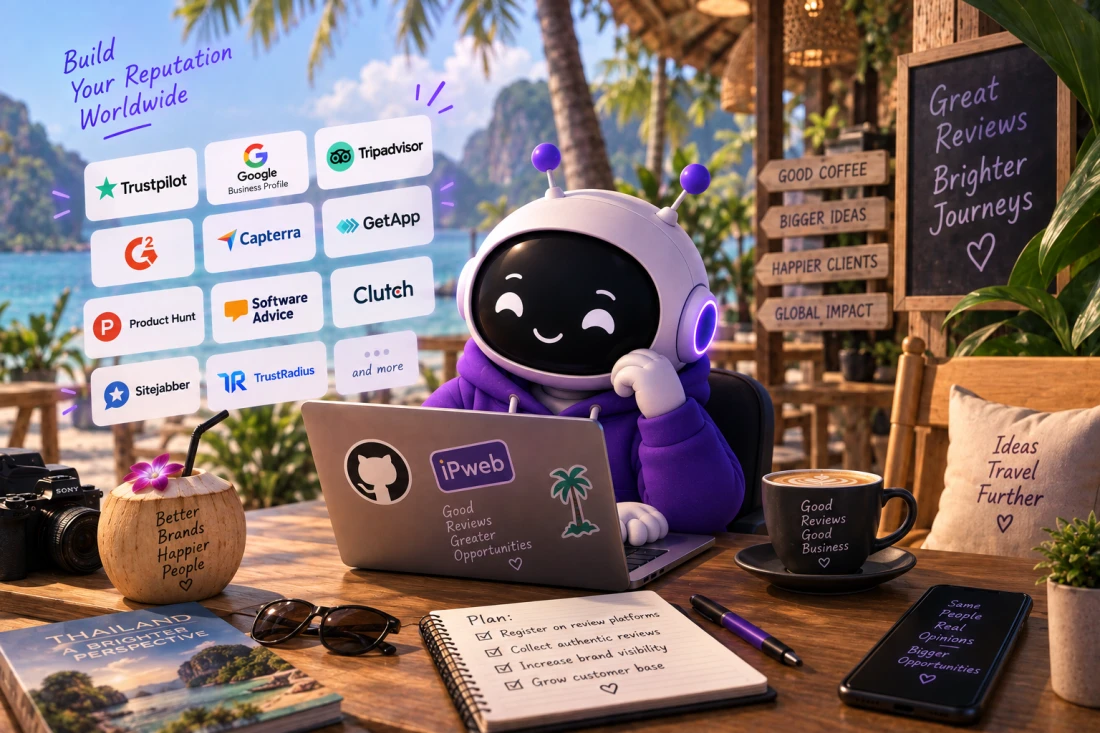
How to Get Reviews for Your Business on Third-Party Platforms: A Personal Experience and a Working Method
Keywords: business reviews, how to get reviews, buy reviews, review platforms, online reputation, Google reviews, Yelp reviews, Trustpilot reviews, collecting customer reviews, review generation
When you launch a business, you run into the same wall pretty fast: the product is ready, the website looks great, the offer is strong — and yet a Google search for your company brings back almost nothing. Someone searches your brand name hoping to read what other people think, and there's simply nothing there. This is a normal stage for any new brand — but it's also the exact moment some potential customers quietly go to a competitor who already has reviews.
This article covers why third-party reviews matter, how to collect them without breaking platform rules, which platforms matter most for English-speaking markets, and shares a personal experience of using IPweb to build up reviews systematically.
Why Third-Party Reviews Matter for a Business
Reviews aren't just a "nice to have" trust signal — they're one of the strongest drivers of purchase decisions.
According to BrightLocal's Local Consumer Review Survey, 97% of consumers read reviews for local businesses, and 83% specifically use Google to find them. The same research found that 74% of consumers check at least two review platforms before making a purchase decision, and 34% check three or more — meaning a business that only has reviews in one place is invisible to a meaningful share of its audience.
Star ratings carry real weight too. BrightLocal's research shows that 71% of consumers would not consider using a business with an average rating below three stars, while 88% say they'd use a business that responds to both positive and negative reviews — compared to only 47% who'd consider a business that never responds to reviews at all. Recency matters as well: consumers increasingly expect to see reviews from the last few months, not just a handful from years ago.
The takeaway is simple: if there's no record of real customer experience on the platforms people actually check, a chunk of your audience drops off before ever reaching a purchase — not because the product is bad, but because there's nothing to compare their expectations against.
My Experience: Building Up Reviews Through IPweb
When I first launched my business and started promoting it, I ran into exactly this problem: almost nobody knew about the company or the product. The website had detailed information, a solid product, and a strong offer — but outside the website there was almost no mention of us anywhere. People would search for the product name, look for reviews and opinions from other users, and find nothing to go on.
To fix this, I started registering the company on various review sites, directories, and other third-party platforms where people share their opinions about products and services. The set of platforms I used depended on the market: promoting in one region called for a different set of directories and review sites than promoting internationally.
Registering alone wasn't enough — I also had to gradually build up genuine reviews and user content on these platforms. This mattered because people searching for terms related to the product — on search engines, social media, or niche platforms — needed to actually find the brand and learn more about it. In effect, these third-party platforms became additional touchpoints with potential customers and started sending extra traffic to the product page.
At the start, the product had no reviews at all. I solved that a few different ways:
- reaching out to real customers and asking them to share their experience with the product;
- asking people I knew to try the product and give honest feedback, where a platform's rules allowed it;
- using services like IPweb, where you can create tasks for users and find people willing to complete them for a reward.
The mechanics on IPweb were straightforward: I'd post a link to the relevant product page or listing, describe the task and the requirements for completing it, and IPweb users would pick up the task and complete it for payment. I started with a small number of reviews per month and gradually increased the volume depending on the niche and the current needs of the business.
I made a point early on of not chasing a large volume of reviews all at once. This is a long-term process that works better built up gradually — starting with a handful of reviews a month and, over time, scaling up to somewhere around 10–20 a month, if that volume fits the niche and the platform's rules.
The Rule I Set for Myself
Working with reviews, I settled on one non-negotiable rule: never try to deceive either the users or the platform itself. I didn't invent features the product didn't have, didn't attribute results to it that it couldn't deliver, and didn't ask people to write only positive reviews. A review needs to reflect a real user experience and contain specific, concrete information about the product — including both strengths and weaknesses, if they genuinely came up during use.
I also learned firsthand that the more detailed and natural a review sounds, the more useful it is to a potential customer. Instead of a generic "great service, loved it," it's far more valuable when a review explains what task the product was used for, what specifically the person liked, which features were useful, what was inconvenient, and what result they ultimately got.
In the end, IPweb let me work systematically with reviews and user-generated content on third-party platforms: I created the task, users picked it up and completed it for a reward, and over time I built up the product's presence in the places where potential customers were actually looking for information about it.
An Important Legal Note for the US and UK Markets
If you're operating in the US, it's worth knowing that the Federal Trade Commission's rule on consumer reviews and testimonials, in effect since October 2024, bans paying for reviews — positive or negative — from people who didn't actually use the product, and it prohibits businesses from suppressing genuine negative reviews. It also requires that any material connection between a reviewer and a business (like a payment or free product) be clearly disclosed. Violations can carry civil penalties of tens of thousands of dollars per incident.
This doesn't rule out incentivized reviews — it means the reviewer has to be a real customer with real experience, and the relationship has to be disclosed where required. That's exactly the same principle described above: pay someone for their time and honest opinion, not for a specific rating or a fabricated story.
Where People Actually Look for Reviews
The right mix of platforms depends on the niche, but most businesses end up working with a combination of these:
General review and business platforms
- Google Reviews / Google Business Profile — the single most-used source for local business reviews; the vast majority of consumers check Google first when researching a business.
- Yelp — still one of the most trusted general review platforms in the US, especially for restaurants, local services, and retail.
- Trustpilot — widely used across the UK and Europe for e-commerce and service businesses, and increasingly common in the US as well.
- Facebook Reviews/Recommendations — relevant for businesses with an active social presence.
- Better Business Bureau (BBB) — less about star ratings, more about trust and complaint resolution, but still checked by cautious buyers.
Travel, local and niche platforms
- TripAdvisor — essential for hospitality, travel, and tourism-related businesses.
- Angi (formerly Angie's List) / HomeAdvisor — for home services and contractors.
- Zillow / Realtor.com reviews — for real estate professionals.
B2B and software platforms
- G2 — the leading review platform for B2B software and SaaS products.
- Capterra and TrustRadius — also widely used for software and business tools, often checked before a demo or a purchase decision.
When choosing platforms, it helps to look not just at overall site traffic, but at which platforms actually appear in Google's search results when someone searches "[your brand] reviews" — that's where your customers are genuinely looking.
How to Collect Reviews Without Breaking Platform Rules
Platforms actively fight fake reviews, and trying to game the system almost always costs more in the long run than doing it honestly.
What review platforms typically flag:
- an unusual spike of reviews in a short window of time, especially from accounts with no prior review history;
- reviews that are vague, near-identical in wording, or lack any specific detail about the product or service;
- reviewer accounts with suspicious patterns — a closed profile, or a history of only ever leaving five-star reviews for businesses in the same industry;
- reviews that don't match the platform's basic content guidelines (no profanity, no personal data, a minimum level of detail).
The practical conclusion lines up with the experience above: get reviews from real people, spread the requests out over time, and make sure each one reflects a genuine, specific experience with the product — rather than trying to get a large batch of similar-sounding reviews all at once.
How to Set the Right Pace
A reasonable approach, backed up by both practice and how platforms actually detect abuse:
- Start small — 2 to 5 reviews a month is a reasonable starting point.
- Increase the volume gradually as the business grows; many niches comfortably sustain 10–20 reviews a month.
- Spread out review requests over time rather than asking for them all at once.
- Encourage real users to describe a specific experience rather than a generic compliment.
- Don't insist on only positive feedback — honest reviews that mention a downside tend to build more trust than a suspiciously perfect five-star rating with no detail.
FAQ
Is it legal to pay for reviews? Platforms and regulators (including the FTC in the US) prohibit fake reviews and reviews from people who never used the product. What's allowed is compensating a real user for their time in writing an honest review of a genuine experience — and disclosing that compensation where required. That's the model services like IPweb are built around: a business posts a task, and a real user shares their actual impression of the product.
How many reviews does a business need to get started? There's no universal number, but most platforms and users already extend some trust once a business has a few dozen detailed reviews with specifics and, ideally, photos. Starting with a handful of reviews a month and building from there works for most niches.
Which platforms should a business prioritize first? For most local or consumer businesses: Google Reviews and Yelp. For hospitality and travel: TripAdvisor. For B2B software: G2 and Capterra. Beyond that, check which platforms actually rank when you search your brand name plus "reviews" — that tells you where your specific audience is looking.
Conclusion
Third-party reviews aren't a one-time campaign — they're an ongoing process that, over time, becomes a real touchpoint with your audience and a source of extra traffic. It only works when it's built on genuine experiences from real people, not manufactured text. My experience with IPweb showed that a systematic, gradual, and honest approach to collecting reviews pays off: the business becomes visible exactly where potential customers are actually looking for it.
If you want to build the same kind of process for your own business, start with a small volume of reviews on one or two key platforms and expand from there, staying within each platform's rules and keeping the feedback genuine.

Internet Marketer