Understanding LinkedIn's 2026 Algorithm: Dwell Time and Retention
How the Algorithm Prioritizes Attention Over Vanity Metrics
LinkedIn's 2026 algorithm prioritizes retention over vanity metrics. Dwell time (how long users spend reading your content) now determines post reach more than likes or follower count. Posts keeping users engaged for 15+ seconds receive algorithmic distribution boosts, while content users scroll past in 2 seconds gets buried. Understanding retention mechanics separates high-performing content from invisible posts in the competitive LinkedIn landscape.
Dwell time measures the time users spend reading or viewing your content, even without clicking, commenting, or liking. LinkedIn's algorithm tracks scroll pauses and read completion to assess content quality. Posts achieving 30+ seconds of dwell time receive "high-quality" classification from the algorithm. Conversely, posts that users scroll past in 2 seconds get algorithmic penalties and reduced distribution. Dwell time now trumps likes for determining virality. A post with 50 engaged readers spending 45 seconds each outperforms a post with 500 quick likes but minimal reading time. This fundamental shift rewards substance over superficial engagement.
LinkedIn's 2026 algorithm evaluates content through three distinct stages. Stage 1 distributes posts initially to close connections (people who regularly engage with your content). Stage 2evaluates early performance based on attention signals (dwell time, "see more" clicks) and conversation quality (meaningful comments versus generic reactions). Stage 3 grants broader distribution to content that performed well in initial evaluation, exposing posts to extended networks and discovery audiences. The algorithm prioritizes "user attention" as the primary ranking factor. Content commanding sustained attention signals value to the platform, earning exponentially wider distribution.
LinkedIn extended the evaluation window from 60 to 90 minutes in 2026. This change gives high-quality content more time to gain organic traction before algorithmic decisions finalize. Many posts that appear to underperform initially spike at the 3-4 hour mark as they reach broader audiences. Don't delete underperforming posts prematurely. Allow the full 90-minute window plus additional hours for distribution to mature audiences. The extended timeline rewards patience and quality over instant gratification. Additionally, engagement pods now risk shadowbanning. The algorithm detects coordinated inauthentic engagement patterns, penalizing accounts that participate in artificial boost schemes.
Key Retention Metrics That Matter
Understanding Benchmarks vs. Your Audience Reality
Every time you search for LinkedIn metrics, you'll find different numbers and benchmarks claiming to show "what works". However, the reality is that everything depends on your content quality and audience preferences. There's no 100% guarantee that posting video will make your content go viral, or that carousels will outperform text posts. What matters most is finding the digestible content format that resonates with your specific users.
Test different formats to discover what your audience prefers. Some audiences engage deeply with long-form text, while others prefer quick videos or visual carousels. The format that generates the most dwell time and engagement for your audience is the right format. When your audience sees you consistently post quality content in formats they enjoy, they will return regularly. Building this habit and trust with your audience outweighs chasing generic benchmarks.
That said, understanding baseline metrics helps you evaluate performance relative to platform standards. Use these benchmarks as reference points, not absolute rules.
Retention Metrics Benchmarks
Dwell Time Targets:
- 15+ seconds for standard text posts
- 30+ seconds for carousels and longer-form posts as readers swipe through slides or scroll deeper content
- Videos under 30 seconds: 50%+ completion rate
- Videos over 30 seconds: 25%+ completion rate
- LinkedIn counts views as meaningful when watch time exceeds 3 seconds minimum
"See More" Expansion Rate:
- Measures whether users click to open collapsed long posts
- High expansion rates indicate strong hooks that create curiosity
- Directly affects the algorithm's quality assessment
- Low expansion rates signal weak opening lines that fail to capture attention
Save Rate Performance:
- Formula: (Saves ÷ Impressions) × 100
- Accounts under 5,000 followers: 0.1-0.4% is good performance
- Saves signal long-term value to the algorithm
- Content users bookmark carries more weight than passive scrolling
Share Rate Impact:
- Formula: (Shares ÷ Impressions) × 100
- Below 1%: needs improvement
- 1-3%: good performance
- 5%+: exceptional, viral-level content
- Shares carry more algorithmic weight than likes or generic comments
- Professionals risk their reputation by sharing, signaling extraordinary value
Engagement Rate Standards:
- Above 5% demonstrates strong content resonance
- CTR of 2-4% is good performance
- Organic posts achieving 2-3% to 5%+ CTR outperform platform averages
- Video posts generate up to 98% higher engagement rates than text-only posts
- Remember: These reflect platform-wide averages—your specific audience may prefer different formats
- Test and measure what works for your community rather than blindly following industry averages
What Makes Thought Leadership Content Retain Attention
Effective thought leadership includes commentary on industry news with clear perspective on implications. Bylined articles demonstrating expertise through original analysis keep readers engaged. Lessons learned through experience offer practical wisdom readers can apply.
Structure content around one clear idea per post supported by context, data, and logical perspective. Multiple competing ideas dilute focus and reduce retention. Single-focus posts allow depth that commands sustained attention.
Content Format Options for Maximum Retention
Your content format should match your audience preferences and your strengths as a creator.Test different formats to discover what generates the highest dwell time and engagement for your specific community. Here are the primary format options with their characteristics:
Short-Form Video (15 seconds to 2 minutes):
- Far more likely to be shared than text posts
- Include relevant descriptions for context—don't rely solely on video content
- Prompt sharing and comments within the video through verbal calls-to-action
- Q&A video clips addressing stakeholder questions perform exceptionally well
- Expert commentary on trends positions you as industry authority
- Both formats deliver value while showcasing expertise authentically
Text + Image Posts (900-1,200 characters):
- Use short sentences under 12 words to maintain reading momentum
- Include 5 portrait-oriented images or one relevant selfie
- Portrait mode increases mobile reach where most LinkedIn users consume content
- Use brand colors in images for visual recall
- Consistent visual identity helps audiences recognize your content before reading who posted it
PDF Carousels:
- Achieve 4.2% engagement rates, outperforming many other formats
- Excel for step-by-step tips or storytelling that unfolds across multiple slides
- Users swipe through carousels, creating longer dwell time as they progress
- Target 15+ seconds retention by designing compelling progression that rewards continued swiping
Native Content vs External Links:
- Native content receives up to 5x more reach than posts with external links
- The algorithm penalizes external links because they move users off-platform
- To maintain reach while sharing external content, post native content and add links in the first comment
- Alternatively, use your bio or Featured section for links
- Keep links off posts entirely to maximize algorithmic distribution
The key takeaway: No single format guarantees success. Experiment with different options, monitor your retention metrics (dwell time, engagement rate, saves, shares), and double down on formats that resonate with your specific audience. What works for one account may not work for another—let your data guide your content strategy.
Writing for Retention: Hook and Structure
Crafting Hooks That Stop Scrolling
The first two lines determine "see more" expansion rates. Lead with provocative questions or bold statements that create curiosity. Avoid generic phrases like "I'm excited to share..." that signal low-value content.
Communicate clear point of view immediately. Readers decide within 2 seconds whether content deserves attention (ambiguous openings lose this critical window). Create curiosity gaps that promise value in exchange for continued reading.
Real-world examples of high-retention hooks:
- "We just shipped outfit Shazam at Aesty 🚀" - This hook works because it leads with a bold product announcement that creates immediate curiosity. The opening line "70% of Gen Z find fashion inspiration on social media, but can't recreate..." identifies a specific problem that resonates with the target audience. The video format demonstrates the product solution, creating natural retention as viewers want to see how it works.
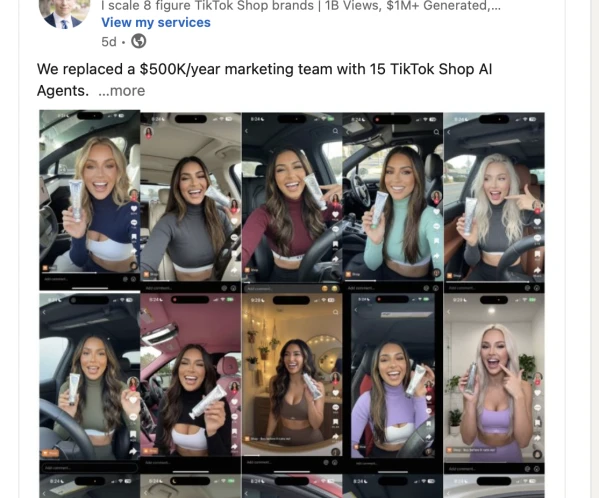
- "We replaced a $500K/year marketing team with 15 TikTok Shop AI Agents" - This hook stops scrolling through a provocative, contrarian claim. The specific dollar amount ($500K) and concrete number (15 AI agents) add credibility while creating curiosity about how this is possible. The visual grid of multiple creator videos provides social proof that extends dwell time as viewers scan the examples.
- "You will NOT substitute your 300K/year marketing team with copy-paste Prompts" - This hook uses contrarian positioning (arguing against AI hype) to capture attention. The all-caps "NOT" creates emphasis and clear point of view. The workflow diagram visual keeps viewers engaged as they try to understand the system being explained.
Building Meaningful Conversations and Community Engagement
Posts sparking discussions see 437% increase in views compared to posts without comments. The algorithm weights comments by relevance, not just volume, one thoughtful comment carries more weight than ten generic "Great post!" reactions. LinkedIn is a conversation platform, not a broadcast channel. Intelligent discussion threads signal content resonance to the algorithm, triggering broader distribution.
LinkedIn users are generally professional and supportive, they're ready to congratulate you, offer help, and show empathy. This is a real networking community that helps you find what you need. It's crucial to comment yourself and write thoughtful, detailed comments on others' posts. Even if a post is short and you just want to leave a reaction, do it. Force yourself to write comments, this is genuinely important because it makes you visible in people's feeds. Commenting on others' posts makes them more likely to see and engage with yours. The "post and run" strategy (publishing without engaging) is dead in 2026.
Encourage people to discuss topics in your posts, this has a powerful effect on performance. When you post interesting topics and people comment and discuss, your profile will perform exceptionally well. Ask thought-provoking questions like "What's your biggest challenge with [topic]?" that invite audiences to share experiences. Avoid generic "Agree?" prompts that generate low-value responses. Pair questions with relevant stats or images to provide context. Invite reflection or response, not just agreement, questions requiring thoughtful answers generate the meaningful engagement LinkedIn's algorithm rewards.
Reply to comments within 24 hours to maintain conversation momentum. Meaningful replies extend discussions beyond surface-level acknowledgments. Each comment interaction boosts post reach 2-3x by signaling active engagement. The first 90 minutes are critical for distribution—early comments signal quality to the algorithm during initial evaluation. Engage with 10-20 posts from ideal clients 2-3x per week to build reciprocal engagement. Consistent interaction creates algorithmic momentum for your content.
Stimulating Discussion with Motivated Traffic
If you want to stimulate people to start discussions, you can use motivated traffic strategically. Configure geo-targeting in the country or region that interests you. Create tasks specifically for generating comments and creating activity. When motivated users from your target geography leave thoughtful comments, other real users will also join the conversation. The initial activity signals to the algorithm that the post deserves distribution, while also creating social proof that encourages organic participation.
Important: Order comments that are relevant and thoughtful, not generic "Great post!" reactions. The algorithm detects comment quality—substantive discussion comments carry far more weight than surface-level reactions. Real users from your target market writing relevant comments create authentic conversation starters that attract genuine engagement.
The Truth About "Optimal Posting Times"
Everyone constantly writes that you need to post at specific times, follow strict posting schedules, that everyone checks LinkedIn on Monday at 8 AM. These are mechanistic rules that sound logical but often don't match reality. Despite algorithms, we're all human, we might log into LinkedIn on Sunday to scroll, check the feed Thursday evening, or browse during lunch breaks at unpredictable times. There is no rigid universal rule about posting times. Yes, weekday mornings often show higher engagement for B2B audiences as general trend data. Yes, LinkedIn analytics can show when your followers are most active. But this data reflects averages, not guarantees.
The most important rule: it's better to post than not to post. A quality post published at 7 PM on Saturday that reaches your audience over the following 90-minute evaluation window (and beyond) outperforms no post at all because you were waiting for "perfect timing". Consistency in posting regularly matters more than perfect timing. Regular posting trains your audience to expect your content and trains the algorithm to distribute it.
Test timing for your specific audience rather than blindly following generic advice. Try posting at different times and days, monitor which posts gain traction, and identify patterns unique to your community. Your audience's behavior may differ significantly from platform averages. Use data to inform decisions, but don't let "optimal timing" paralysis prevent you from publishing valuable content.
Leveraging LinkedIn Features and Tools for Retention
Strategic Hashtag Use
Use 3-5 relevant hashtags per post. Mix broad and specific hashtags to balance discovery and targeting. Hashtags aid discoverability for users following topics. Research hashtag performance before using—popular hashtags provide reach while niche hashtags ensure relevance.
Tagging Strategy
Tag 2-3 relevant people per post to extend reach. Tag subject-matter experts to add credibility and invite their perspective. Avoid over-tagging, which appears spammy. Tags create notifications that bring tagged individuals to your content, often generating engagement.
Growing Quality Network
Connect with quality connections, not just quantity. This is critical: algorithms detect mass connection requests and flag accounts as spammers. Add only relevant people whose interests, industry, or expertise align with yours. Random connection requests harm your account standing and reduce content distribution.
Engage consistently with industry leaders whose content aligns with your interests. Attend events and connect with presenters to build authentic relationships. Build your network based on shared interests and mutual value, not connection count.
Using Motivated Traffic to Boost Retention Signals
Motivated traffic is a powerful tool that significantly impacts retention and ranking. When real users visit your profile, read your posts, leave comments, react, and connect with you, these signals tell LinkedIn's algorithm your content is valuable. People who fully read your posts (dwell time) undoubtedly influence ranking.
It's crucial to use motivated traffic correctly. Services like ipweb allow you to configure geo-targeting and select users specifically from regions relevant to your business. For example, if you're based in Turkey and targeting European markets, don't order traffic from India if the Indian market isn't relevant to you. Geographic mismatch creates engagement from audiences that won't convert into real business relationships.
Best practices for motivated traffic on LinkedIn:
- Target your actual market geography (if you serve US clients, order US-based users)
- Focus on profile visits, post reads (dwell time), and meaningful reactions
- Ensure users reach your content organically through search or recommendations, not just direct links
- Start with modest volumes (10-30 actions daily) and scale gradually
- Combine motivated traffic with quality content—traffic amplifies good content but can't save poor content
Motivated traffic works because LinkedIn's algorithm tracks:
- Time spent reading your posts (dwell time 15+ seconds signals quality)
- Profile visits and connection requests from relevant professionals
- Comments and meaningful engagement on your content
- Saves and shares indicating long-term value
When real users from your target geography perform these actions, the algorithm interprets your content as valuable to that professional community and distributes it more widely. Combined with the other retention strategies in this guide, motivated traffic becomes a force multiplier for content performance.
LinkedIn in 2026 rewards not those who shout the loudest, but those who hold attention the longest . When you focus on depth, clarity, and practical value in your posts, dwell time, saves, comments, and shares grow naturally. The key is not chasing "perfect posting times" or vanity metrics, but systematically testing formats, refining your hooks, and building genuine discussions around your ideas . Add strategic use of motivated traffic targeting the right geography, and you transform each post into an asset that lives long in the feed and consistently strengthens your personal brand. Ultimately, the winners are those who consistently deliver meaning and value to their audience, not those who simply appear in the feed most often.

SMM Expert