When people talk about promotion, the first things that come to mind are ads, SEO, influencers, content marketing. Comments almost never make that list — which is a shame, because that's exactly where something close to genuine peer-to-peer recommendation happens every single day.
Every day, users ask the same question in search results and in threads: "what does everyone use for...". Under YouTube videos, in Reddit discussions, in posts on X and LinkedIn, in Telegram groups — people are, in effect, asking strangers for advice, and getting it. I got curious whether it was possible to plug into that process and tell people about my product in a way that reached the people who could actually use it, instead of a random ad-banner audience. I decided to test the idea through IPweb and see how realistic it actually is to scale this kind of point-by-point, inherently "manual" work.
What mass-commenting is and why it matters
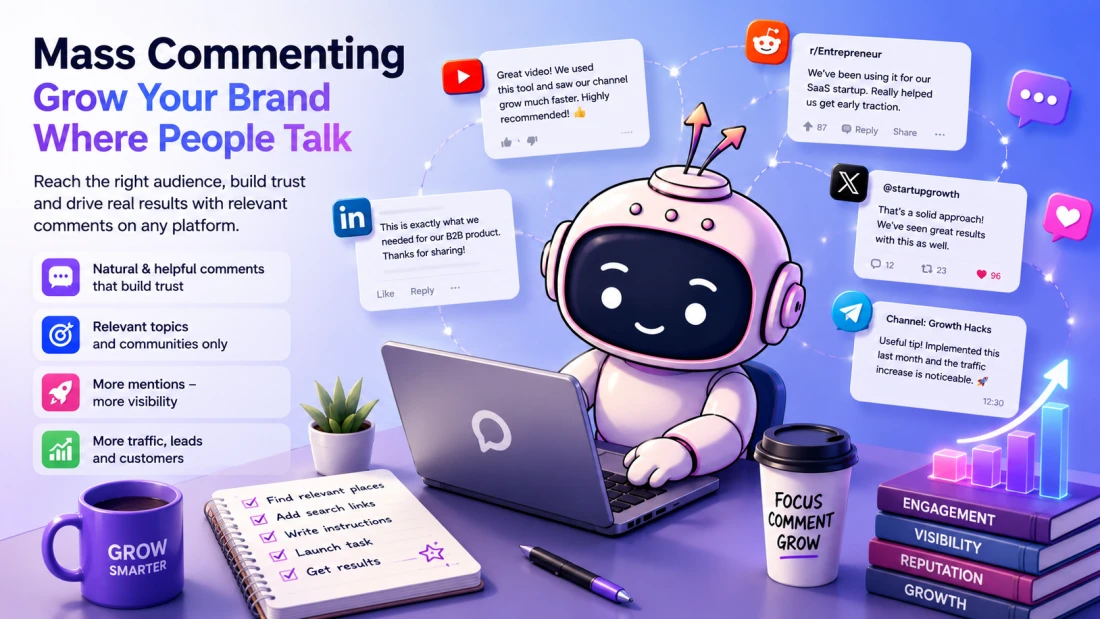
Mass-commenting is promoting a product through genuine, unique comments under existing discussions, rather than through direct advertising. The idea is simple: if people are already asking for recommendations in comments, someone is answering those questions anyway. The question is whether your product ends up among those answers — not as an ad, but as an honest, on-topic suggestion.
That's where the fork in the road appears. One option is hiring one or two freelancers and asking them to manually find posts and leave comments — slow, and it doesn't scale, since one person can't physically track dozens of active discussions a day across different platforms. The other option is a microtask marketplace, where many performers respond to a single task, each finding their own post and writing their own unique comment. I went with the second path and created a "Comments" task on IPweb.
How to write a comment task that actually works
My first version of the brief was short: "leave a comment mentioning the product under a post about productivity." Within a couple of days it was clear that wasn't enough — some comments read like they'd been written by a bot that had only skimmed the headline.
I rewrote the brief with specifics: what kind of comment was expected, exactly what had to be mentioned about the product, what tone to use — no corporate phrasing, no obvious sales pitch. I added a few examples of good comments so performers had a live reference point instead of a vague "just write naturally." I also added a section on what was off-limits: no link-dropping where it reads as spam, no mentioning the product in a thread where it's simply not relevant.
Comment quality went up noticeably after that. It wasn't about the performers — it was that a detailed brief removes the need for someone to guess at the task. A good performer, given clear boundaries, opens the post, reads the whole thread, figures out what people are actually arguing about, and only then writes a reply that fits the conversation instead of sticking out as an obvious insert.
Finding places to comment without manually collecting links
I expected the hardest part to be finding suitable posts — manually scanning hundreds of discussions to build a list of links. In practice it turned out to be simpler: instead of a static list of links, I used saved search queries.
I took a handful of phrases close to the product's topic — things like B2B SaaS, CRM for small business, productivity tools, marketing automation — and built platform-specific versions of each query: one set for Reddit, one for YouTube, one for LinkedIn, one for X. Then I filtered results to the last week or month, copied the link to the search results page itself, and used that link in the task instead of a specific post.
That turned out to be more useful than it sounds. When a performer opened the task, they landed on that live results page and picked whichever post fit the moment. I didn't have to log in every day and refresh a link list — the search engine kept things current, not me.
Where this actually worked
I ran tasks across several platform types: YouTube, Reddit, X, LinkedIn, Telegram, a few niche forums, and a couple of review sites. The difference between them wasn't in the mechanism — it was in tone. What reads as normal on Reddit often looks too casual for LinkedIn, and vice versa. So it's worth adjusting the brief per platform, mostly on style, not substance.
One condition matters everywhere equally: how active the discussion is. A comment under a years-old post whose last reply was long ago won't be seen, no matter how much effort goes into it.
Comment geo-targeting: why setting a performer region matters
One detail that's easy to overlook at the start is audience geography. If a product is aimed mainly at users in one country, comments from other regions miss the mark twice over — the example in the text won't land, and the recommendation itself will look out of place.
IPweb lets you set a performer region, so you can specify the target country directly in the task, and only performers from there will pick it up. That matters for another reason too: search results themselves differ by region — what a user in one country sees for a given query can look noticeably different from what someone in another country sees — so the posts performers find will be more relevant to the actual target market.
What to know before running this on English-language platforms
Before running this playbook on Reddit, LinkedIn, X, or YouTube for a US or English-speaking audience, it's worth knowing the current rules, because they've tightened significantly.
The US consumer protection regulator (the FTC) enforces a rule on the honesty of reviews and endorsements: reviews that misrepresent whether the person actually used the product are prohibited, and any material connection between the reviewer and the business must be disclosed. Framing it as "this isn't an ad, just a comment" doesn't exempt a paid, undisclosed comment from the disclosure requirement.
Reddit doesn't ban brand-affiliated accounts outright, but it explicitly prohibits disguising promotional activity as organic content — fake usernames, mimicking a regular community member, coordinated engagement manipulation. That's grounds for a permanent ban.
LinkedIn actively fights coordinated and automated engagement (so-called engagement "pods"), reducing reach for detected accounts and removing tools that automate this kind of activity.
None of this means the underlying idea doesn't work — a genuinely useful comment written by a real person is still exactly that. But for this market, the more durable version of this playbook adds a lightweight disclosure (something like "full disclosure, I use this product myself, happy to share more") rather than relying on the comment being indistinguishable from an organic one. It also means keeping any coordinated commenting activity at a human pace, without signs of automation — both Reddit and LinkedIn are now primarily hunting for coordination patterns, not just keywords.
What it produced
The result doesn't show up as a single spike — it builds gradually. Mentions of the product accumulate in the places where the target audience already is. People find out about the service inside a discussion they started themselves, not from an ad. Referral traffic increases, organic brand mentions across the web grow, and the product itself starts surfacing in the same threads where users search for similar tools, without further input from the advertiser.
There's an effect advertising doesn't produce: a well-written comment keeps sending people long after it's posted, because the thread it lives in keeps circulating in search and in the platform's own recommendations.
The main takeaway is that mass-commenting only works when the comment is genuinely useful to the person reading it. Every time you try to cut corners — mentioning the product where it doesn't fit the discussion, or reusing the same text under different posts — the result goes the other way, both in engagement and in how it's received. The logic that actually works is the opposite one: the comment should read like ordinary-user advice answering a specific question, helping solve the original poster's problem, and only mentioning the service if that's genuinely relevant.
FAQ
Is mass-commenting spam? No, if every comment is written for a specific discussion and answers a real question in it. It becomes spam when the same text gets mechanically copy-pasted under different posts without regard for context.
How do I find places to comment without manually collecting links every day? Instead of a static list of links, use a saved search query for the relevant topic — the performer then finds a current, relevant post in the live results at the moment they do the task.
Can commenting be limited to a specific country? Yes — IPweb lets you set a performer region, so only users from the specified country will pick up the task.
Do I need to disclose that a comment is sponsored, for a US audience? Yes. The FTC's rule on consumer reviews and testimonials requires disclosure of any material connection between the commenter and the business. This is worth building into the brief for US-facing campaigns as a required step, not an optional one.
Conclusion
Mass-commenting remains a working promotion tool — it just requires a different mindset than a mass ad blast. A detailed brief for performers, platform discovery through saved search queries instead of manual link collection, and geo-targeting for the right market are the three things that determine the result. For an English-speaking audience specifically, building in a lightweight disclosure is what separates a durable channel from one that risks a regulatory warning or a platform ban.
If you want to try this approach yourself, a comment task with the right parameters can be set up in IPweb.

Internet Marketer