For most developers targeting English-speaking users, distribution planning stops at the Apple App Store and Google Play. That leaves reach on the table: device-specific stores like Samsung Galaxy Store, Amazon Appstore, and Huawei AppGallery reach users who rarely browse the two majors, often at a lower cost per install. This guide covers which app stores matter for the English-speaking market, how they compare in scale, and what promotion actually works in each one.
Introduction: Why App Stores Still Matter
Why distribution channels are not interchangeable
The App Store and Google Play run on different ranking logic, different metadata rules, and different card formats. A listing tuned for Google Play won't automatically convert on the App Store — the keyword mechanics, search algorithm, and creative requirements are simply not the same. That means promotion strategy has to be built store by store, not copy-pasted from one metadata set.
Why the English-speaking market is a logical starting point
"English-speaking" isn't one audience. The US, UK, Canada, and Australia differ in purchasing behavior, interface expectations, and even spelling conventions. Even so, these markets deliver the largest paying user base and the most mature ASO tooling available, which makes them a practical entry point before expanding into other regions.
Consumer app stores vs. alternative distribution channels
Beyond public app stores, there are alternative channels — OEM preloads, enterprise distribution, PWA web installs. These solve narrower problems and typically complement, rather than replace, public stores. This article focuses on consumer app stores, where users actively search for and install apps themselves.
The Main App Stores to Cover
Apple App Store
The primary store for iOS and one of the two channels every launch has to cover. Strict review process, high bar for listing quality, and organic search still carries real weight in install volume.
Google Play
The main Android store with the broadest availability worldwide. Ranking here leans more heavily on behavioral signals — retention, rating, uninstall rate — than on text relevance alone.
Samsung Galaxy Store
Preloaded on Samsung devices, reaching users who rarely go looking for alternative stores on their own. Particularly useful for apps aimed at flagship-device owners.
Amazon Appstore
Focused on Amazon hardware (Fire TV, Fire tablets) plus a segment of Android phones. Relevant for media-consumption and smart-home categories in particular.
Huawei AppGallery
One of the largest alternative app stores worldwide, with real scale in China, the Middle East, and parts of Europe and Latin America. For the English-speaking market specifically, treat it with a caveat: Huawei has essentially no mainstream retail presence in the US, and UK availability is limited mostly to grey-market imports and direct Huawei channels, since most devices launched there no longer ship with Google services. AppGallery is worth covering if a real segment of your audience already owns Huawei hardware — not a default priority for a US/UK-first launch.
Microsoft Store
Home for Windows apps and part of the cross-platform install base. Audience is narrower, but competition for category placement is usually lower, which makes ranking easier to reach.
Xiaomi GetApps
Xiaomi's device store. Xiaomi devices do have a real, if modest, foothold in the UK market through carrier partnerships, and phones sold there typically still ship with Google Play as the default store — GetApps functions as a secondary, pre-installed channel rather than the primary path to install.
Oppo App Market
Same logic as other OEM stores: preloaded on Oppo devices, useful as a supplementary channel within a broader multi-store publishing plan, particularly where Oppo has carrier-driven share.
Vivo App Store
Another device-level store worth adding when extending coverage beyond the two majors, particularly in the budget and mid-range smartphone segment.
OneStore
A regional store historically strong in South Korea, included here as a niche channel for developers running a wide publishing portfolio rather than a priority for English-speaking markets.
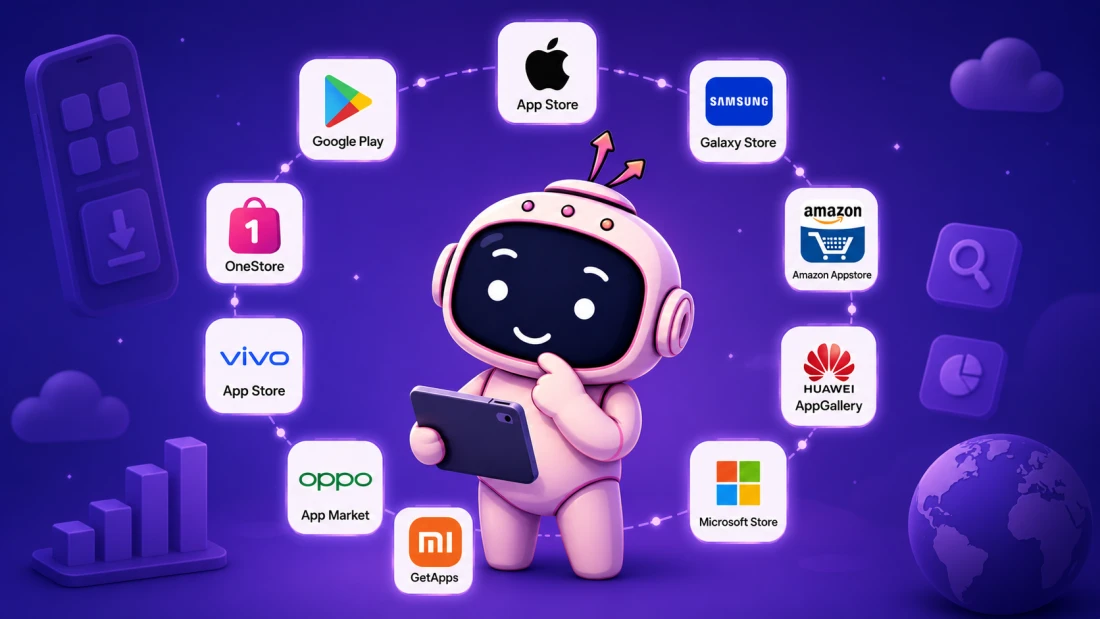
These ten platforms cover the vast majority of distribution scenarios in the English-speaking market. Priority always goes to the App Store and Google Play; the rest get added as the product grows, based on which devices your actual audience is using — not on a store's global footprint alone.
Grouping stores by priority — core, secondary, and niche — makes this manageable instead of trying to cover everything at once. It also lets the team build a working process on the channels that matter most before spreading resources thin.
Market Size and Relative Scale
|
Tier |
Stores |
Scale |
|
Tier 1 |
App Store, Google Play |
Core global channels, maximum reach |
|
Tier 2 |
Amazon Appstore, Samsung Galaxy Store, Microsoft Store |
Meaningful reach for English-speaking audiences, notably smaller than Tier 1 |
|
Tier 3 |
Huawei AppGallery, Xiaomi GetApps, Oppo App Market, Vivo App Store, OneStore |
Large globally in some cases, but limited reach specifically among US/UK/CA/AU users; useful mainly for extending coverage to matching device owners |
Tier 1 stores: Apple App Store and Google Play
These two cover the majority of installs for most app categories and remain the mandatory starting point regardless of region.
Tier 2 stores: device and ecosystem stores with real English-market reach
Amazon Appstore, Samsung Galaxy Store, and Microsoft Store deliver meaningful, if smaller, reach specifically among English-speaking users. Worth adding once analytics confirm a real share of matching devices in your target audience.
Tier 3 stores: global scale, limited reach in English-speaking markets
Huawei AppGallery is genuinely large as a global platform, but its footprint among US and UK users is small — worth noting separately from stores like Xiaomi GetApps, Oppo App Market, and Vivo App Store, which have modest but real device share in markets like the UK. OneStore has essentially no relevance here and is included only for completeness. Adding any of these stores usually makes sense as part of a broader, multi-region strategy rather than an English-market launch priority.
When judging scale, don't confuse catalog size or global user base with reach in a specific market: a store can be genuinely massive worldwide and still be nearly irrelevant for a US or UK audience. The practical takeaway is to base decisions on what share of your target audience a given store actually delivers in your category and region — not on the store's headline global numbers.
Apple App Store: Promotion Features
Metadata optimization
Title, subtitle, and the keyword field make up the core of text relevance in App Store search. Precision matters more than volume here.
Product Page Optimization
Apple lets you test different combinations of icon, screenshots, and preview video against different traffic segments to find the highest-converting version. PPO is limited to visual assets — title, subtitle, and keywords are updated separately through standard metadata submissions.
Custom Product Pages
Custom Product Pages (CPPs) let you build alternate versions of your listing for specific campaigns, audiences, or channels — each with its own URL. They used to be a paid-traffic-only tool, but that's no longer the case: CPPs can now be tagged with keywords and surface directly in organic App Store search, not just through ad links. That makes them relevant well beyond paid campaigns — a CPP built around a specific feature or use case can now earn organic visibility on its own.
Screenshots, preview videos, and icon testing
Visual elements often move conversion more than copy does, so regular A/B testing of the icon and first screenshots is standard practice for growing apps.
Localization for US, UK, CA, and AU audiences deserves its own attention — wording and cultural references shape how the listing lands with each. Review management and social proof also matter for trust: a developer response to a negative review often changes a prospective user's decision.
Google Play: Promotion Features
Store listing optimization
Google Play relies on the combination of short description, full description, and creative assets, and the full description is indexed more fully than App Store text, giving more room for natural keyword use.
App size and install success
A large APK/AAB increases drop-off during install, especially on slower connections, so trimming app size is as much a marketing lever as a technical one.
Store listing experiments
The built-in Store Listing Experiments tool lets you test icon, feature graphic, screenshots, short description, and full description against live traffic, running up to three variants against a control across several languages at once, and pick the best-converting version.
Localization and language variants
Google Play supports separate locales, which means listings can be adapted not just by language but by regional details — pricing, units, phrasing.
Technical quality — stability, launch speed, crash-free sessions — directly affects search ranking, since the algorithm factors in behavioral signals: retention and how quickly users uninstall after installing.
Promotion in Secondary Stores
Samsung Galaxy Store
Follows device-ecosystem logic: promotion works best when the app solves a problem specific to Samsung users, from integration with first-party services to placement in the store's curated collections.
Amazon Appstore
Regional availability and Amazon-device-specific categories matter here. Getting into partner placements can meaningfully lift impressions without a large paid budget.
Huawei AppGallery
Technical compatibility with an HMS build is required, along with participation in curated collections and partner programs, which can significantly affect early visibility. For English-speaking markets, treat this as an opportunistic channel rather than a default one — worth the setup cost mainly when analytics show a real segment of Huawei device owners in your audience.
Microsoft Store
Promotion here benefits from lower category competition and the chance to land in the store's editorial picks by meeting quality requirements.
The general rule across secondary stores is the same: add them when there's a partner placement, preload deal, or a real share of the target audience on those devices — enough to justify the ongoing cost of maintaining a separate listing.
ASO Strategy by Store
Keyword strategy
App Store keywords go into a dedicated metadata field and subtitle; Google Play relies on the description and short description. These are different mechanics, and reusing the same keyword set without reformatting it is a common mistake.
Title and subtitle rules
The title should communicate the product instantly; the subtitle should reinforce it with a clear category or value cue, without repeating the same phrasing twice.
Description structure
A strong description answers "why this app" in the first lines, then breaks functionality into clear blocks — easier to scan for users and better indexed on Google Play.
Visual assets
Screenshots should read as a usage story rather than a random set of interface screens — the first two or three frames usually decide whether a user scrolls further.
Testing methodology depends on running experiments regularly: ranking signals (text relevance, behavioral metrics) and conversion signals (visuals, reviews, price) need different treatment, and copy should be rewritten for each store's English variant rather than copied straight across.
Paid Promotion and External Traffic
Search ads inside app stores
Apple Search Ads and Google Ads' Play Store campaigns get visibility on competitive terms before organic ranking has had time to build. Pointing ad groups at a keyword-matched Custom Product Page instead of the default listing tends to noticeably outperform default-page ad groups on the same spend and keywords.
Social media traffic
Social platforms bring targeted audiences in before organic search alone can carry the load.
Influencer and content-driven acquisition
Reviews and recommendations from creators build trust faster than direct ads, especially in niche categories with an engaged audience.
UGC and review generation
Encouraging organic reviews and user-generated content boosts listing conversion and doubles as a source of new keyword phrases for the description.
Landing pages and pre-landers filter out low-intent traffic before it hits the store, and proper attribution shows which channel is actually moving organic rank versus which one is just spending budget. Paid-to-organic balance is worth revisiting regularly — paid traffic can jump-start organic growth, but it doesn't replace a solid ASO foundation.
Ratings, Reviews, and Trust
Why reviews affect conversion
Rating and review count are among the first signals a user checks before installing, especially in competitive categories.
How to increase review volume ethically
A well-timed, low-friction review prompt after a positive interaction — say, after a user completes a key action — outperforms an intrusive pop-up shown right at first launch.
How to handle negative feedback
A calm, specific public response to a negative review often matters more than the review itself: it signals to future users that the team actually responds to problems.
Getting the timing of review prompts right and having a working support process in place builds the kind of trust English-speaking users tend to look for — most read both the rating and the most recent comments before installing.
Localization for English-Speaking Markets
US English
The default baseline for most international launches, with a direct, concise tone.
UK English
Differs in spelling and leans toward a more understated tone — a straight US copy often reads as neutral rather than native.
Canadian English
Blends US and UK conventions, and requires care with pricing and local units of measurement.
Australian English
Has its own tone and slang worth accounting for in marketing copy, not just product text.
Cultural differences in wording and visuals aren't a cosmetic detail — they're a conversion factor. One universal English version works fine for launch, but as a specific region's audience grows, localizing keywords and copy for that market usually pays off in higher conversion.
Technical and Content Requirements
Minimum app quality
Stable performance with no critical bugs is the baseline condition for reaching the top of any category in any store.
App size and install friction
The heavier the build, the higher the risk a user abandons the install on a weak connection — a direct hit to impression-to-install conversion.
Store compliance
Every store enforces its own rules on content, permissions, and listing formatting, and violating them can get a listing rejected.
Visual and copy consistency
A gap between what the screenshots promise and what the app actually delivers drives up negative reviews and uninstalls.
Permissions, crash stability, and update cadence deserve attention too — all of them quietly support promotion performance even though they sit on the product side rather than the marketing side.
Safe Growth, Fraud Prevention, and Policy Risks
What stores usually penalize
Install fraud, purchased reviews, and suspicious traffic spikes are the standard triggers for moderation action and penalties.
Fake reviews and incentivized ratings
Using review-boosting services violates most store policies and can lead to review removal, rating suppression, or listing takedown.
Review manipulation and account risk
Repeat violations can affect not just one app's listing but the developer account's standing overall.
Suspicious traffic and install spikes
Sudden, unnatural jumps in installs without a matching rise in impressions are one of the first patterns fraud-detection systems flag.
App stores are getting better at spotting abnormal behavior by analyzing traffic patterns, impression-to-install ratios, and review growth rate. Violations can hurt an app's search visibility or the developer account's status, and recovering from a penalty usually takes far longer than growing organically from scratch. Sustainable growth is built on real user signals — not simulated ones.
Recommended Publishing Priorities
Launch first on Apple App Store and Google Play
For the vast majority of products, this is the mandatory starting point — it's where the largest active and paying audience already is.
Add secondary stores selectively
Expansion into Samsung Galaxy Store, Amazon Appstore, Microsoft Store, and — where the audience data supports it — Huawei AppGallery or the Xiaomi/Oppo/Vivo device stores, should follow analytics confirming a real share of matching devices in your audience, not a store's global size.
Prioritize by device mix and target geography
Choosing the next channel should be based on actual device distribution data for your users, not assumptions about a store's overall size.
Expanding past the two majors makes sense once ASO processes on Tier 1 are running smoothly and the team has bandwidth to maintain additional listings. Before scaling, measure baseline metrics — impression-to-install conversion, retention, acquisition cost — so new channels get judged against the same criteria as the core ones. Channel selection also depends on app category: media and smart-home apps often see an early lift from secondary stores, while niche B2B products may not need the extra coverage at all.
FAQ
Do I need to publish on all ten stores right away? No. For launch, App Store and Google Play are enough. Add the rest based on growth and real data about which devices your users actually have.
How does ASO on the App Store differ from ASO on Google Play? On the App Store, keywords live in a dedicated metadata field and the subtitle. On Google Play, the full-text description and behavioral signals like retention and uninstalls carry more weight.
Should I use the same listing copy for the US, UK, Canada, and Australia? One English version is fine to launch with, but as a specific region's audience grows, localizing wording and visuals for that market usually improves conversion.
Is Huawei AppGallery worth publishing to for a US or UK audience? Usually not as a priority. AppGallery is a major store globally, but Huawei has very limited retail presence in the US and mostly grey-market availability in the UK, so the return for an English-market-first app is typically low unless your analytics show a real Huawei-device segment in your audience.
What most often triggers store penalties? Install fraud, purchased reviews, and unnatural traffic spikes — these patterns are exactly what moderation systems are built to catch first.
Conclusion
The app store ecosystem for the English-speaking market is bigger than it first looks: beyond the App Store and Google Play, there are eight more platforms, each with its own audience and promotion logic — though not all of them carry the same weight for US, UK, Canadian, and Australian users specifically. The core principle stays the same across all of them: adapt metadata, visuals, and localization to each store's rules instead of reusing one listing everywhere, and judge every additional store by the real device mix of your audience rather than its global footprint.
Start by launching on the Apple App Store and Google Play, get ASO and review generation working there, then add secondary channels based on real device-distribution data. From there, it's worth testing one or two Tier 2 stores before considering the stores with strong global scale but limited reach among English-speaking users.
If you need to build a full promotion strategy across multiple app stores — from ASO audits to organic review generation and traffic management — IPweb helps developers set up that process systematically, tailored to each platform's specifics.

Internet Marketer