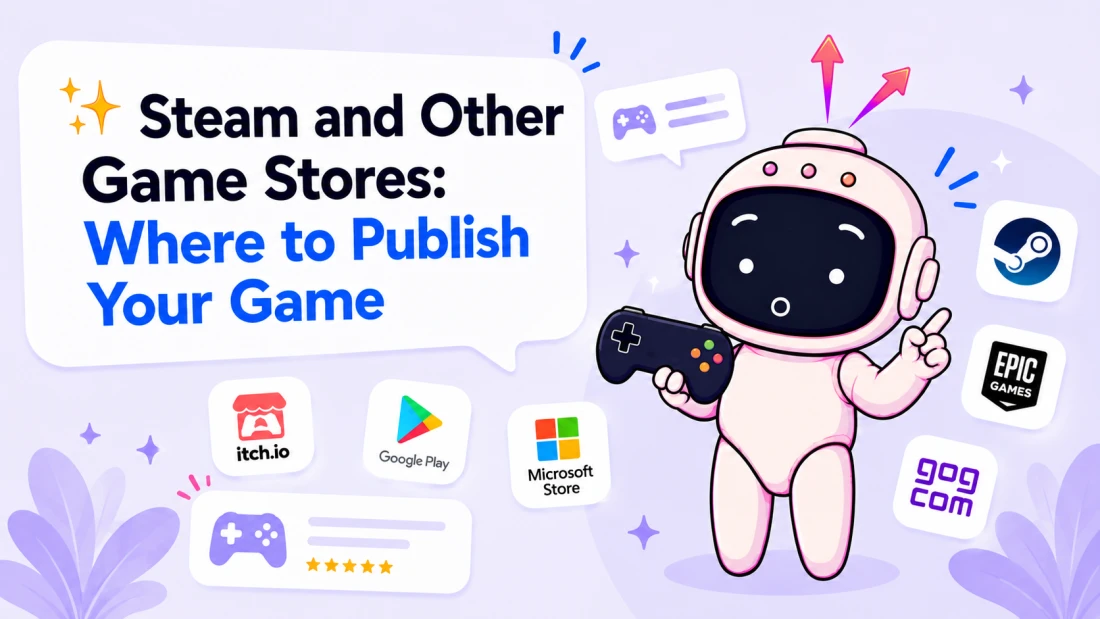
Getting a game in front of players used to mean burning a disc or hosting a download link and hoping people found it. Today it means picking the right storefronts — and understanding what each one actually costs, requires, and rewards. This guide walks through Steam and its realistic alternatives across PC, console, mobile, and web, how to promote a game once it's live, and how to recognize when a competitor is gaming the system instead of earning their ranking.
What Steam Direct Is and Why You Need a Distribution Platform
A digital storefront does more than list your game for sale. It handles payment processing and fraud protection, gives you a discovery surface where players who've never heard of your studio can stumble onto your page, and provides the community layer — reviews, forums, wishlists — that turns a one-time buyer into someone who tells their friends. Shipping a standalone installer from your own website skips all of that: no built-in audience, no trust signal from a recognizable platform, and you're on your own for payment security and piracy protection. For nearly every developer, a storefront isn't optional infrastructure — it's the product's actual point of sale.
How Much It Costs to Publish on Steam: The Steam Direct Fee
Publishing through Steam Direct requires a $100 fee per game (or the local-currency equivalent), paid once you're ready to submit. It isn't refundable, but it is recoupable: once your game generates at least $1,000 in Adjusted Gross Revenue, Valve credits the fee back to you as a line item in your payout report, so it's really a refundable deposit rather than a sunk cost. If your payment method for the original deposit gets charged back, refunded, or flagged as fraudulent, both the revenue payout and the fee recoupment can be withheld, so it's worth using a clean, verifiable payment method from the start.
Before Valve pays you anything, you'll also need to complete a tax interview — a W-9 for US-based developers or a W-8BEN for developers outside the US — through your Steamworks account. This isn't unique to Steam; every major platform in this guide requires some form of tax documentation before your first payout, so budget time for it early rather than scrambling once your game is ready to launch.
Step-by-Step: Registering and Publishing Through Steamworks
Getting a game live on Steam follows a fairly linear process:
- Create a Steamworks account tied to your Steam account, and register as a partner.
- Pay the $100 Steam Direct fee for the specific game you're publishing.
- Complete your tax and banking information so Valve can actually pay you once sales start.
- Build your "Coming Soon" store page — this is where wishlists start accumulating, often weeks or months before launch.
- Upload your build through SteamPipe, Valve's content-delivery and build-management tool.
- Submit for review and wait for Valve's approval before your page and build go live to the public.
The earlier you get the "Coming Soon" page up, the more time you give wishlists to accumulate — and wishlist momentum, not just raw count, is one of the biggest levers you have over Steam's own discovery algorithm, which we'll cover below.
What Valve Actually Checks Before Approving Your Store Page
Valve's review isn't a curation gate in the way console certification is — most reasonably functional games get through — but it does check for baseline technical stability, correct store page content (accurate screenshots, no misleading claims), and compliance with Steam's content policies around things like age-appropriate labeling and prohibited content categories. Turnaround is typically measured in days rather than weeks for a straightforward submission, though incomplete store pages or flagged content can add delay. Treat the review less as an obstacle and more as a final quality check before your game meets real players.
Best Alternatives to Steam: Epic Games Store, GOG, itch.io, Humble
Steam is the default first stop for most indie developers, but it's far from the only serious option, and each alternative has a genuinely different value proposition.
Epic Games Store has offered free self-publishing since March 2023 and gives developers an 88% revenue share — among the most generous cuts of any major PC storefront, versus Steam's standard 30% cut (which steps down to 25% and 20% at high sales volume). Epic also throws in free IARC content ratings and waived Unreal Engine royalties for games published there, which meaningfully lowers the cost of entry if you're already building in Unreal. Epic reports well over 68 million monthly active users by its own prior figures, and it's earned a real position as the strong #2 PC storefront.
GOG.com, run by CD Projekt, is a curated store rather than a fully self-serve one — not every submission gets accepted — and its standard commission sits around the industry-typical 30%. What GOG offers instead is reputation: it's the go-to DRM-free platform, respected by a specific, loyal segment of PC gamers, and getting featured there puts your game in front of roughly 8 million newsletter subscribers.
itch.io is the most open of the group: free registration, no business entity required, and — unusually — you set your own revenue cut, anywhere from 0% to 100%, with about 10% as the suggested default. It's built its reputation as the world's most popular indie platform by sheer content diversity and a genuinely loyal community, making it a strong fit for experimental, niche, or early-access releases that wouldn't necessarily find their footing on a bigger storefront yet.
Humble Store / Humble Bundle isn't fully open either — getting in typically requires curator approval — and once you factor in charity and publisher revenue shares on bundle deals, the effective cut can run past 25%. What you're buying with that is Humble's strong brand trust and its built-in bundle and sale audience, which can be a meaningful discovery channel if your game fits their curation style.
Publishing on Consoles: Xbox, PlayStation, and Nintendo Certification
Console publishing is a genuinely different proposition from PC: registration is free across all three major platforms, but each requires a signed agreement and a multi-week certification process before your game can go live — a real barrier compared to Steam's largely automated listing flow, though a realistic one for a well-resourced Tier-1 studio with legal and QA capacity.
Xbox (ID@Xbox / Partner Center) registration is free through the Xbox Onboarding Hub, but you'll need a mutual NDA in place before you get access to the GDK. Certification against Xbox's requirements — stability, achievement implementation (typically 10 to 100 achievements totaling at least 1,000 Gamerscore), save-game handling, multiplayer behavior, and connectivity — happens on retail hardware. Full onboarding through to Partner Center registration typically takes around two weeks end to end.
PlayStation (PlayStation Partners) requires a free application through register.playstation.net, but you'll need to show proof of legal business status and a private-domain email address, then sign Sony's Global Developer and Publisher Agreement. Certification follows Sony's Technical Requirements Checklist, covering application lifecycle behavior, save-data integrity, the Trophy system, and recovery from a disconnected controller. Third-party estimates put each certification round at roughly two to four weeks, plus additional delay for any resubmission after a failed item.
Nintendo (Developer Portal) registration is free and open — no company affiliation required — through a standard application plus a separate Switch Access Request form, with a mandatory NDA. Certification, known as Lotcheck, is widely considered the strictest of the three: it scrutinizes sleep-mode handling, Joy-Con behavior, and resistance to save-data corruption, tested across both handheld and docked performance. Sleep-mode failures are the single most common rejection reason, and review typically runs two to four weeks.
Across all three, the pattern is consistent: free to register, but budget real time — and QA capacity — for certification, since a failed pass usually means resubmission and another review cycle rather than a quick fix-and-continue.
Mobile and Web Platforms: App Store, Google Play, and Casual Portals
If console certification timelines don't fit your team's resources yet, mobile and browser-based platforms offer a lower-friction way to get a game in front of players.
On mobile, Apple's App Store requires a $99/year Apple Developer Program membership, with a standard 30% commission that drops to 15% for developers earning under $1 million a year through the Small Business Program. Google Play is a one-time $25 registration fee, with a 15% service fee on a developer's first $1 million in annual revenue, standard 30% above that, and select programs offering reduced rates as low as 10–20%. Amazon Appstore registration is free, with monetization available through paid downloads, in-app purchases, and ads.
On the web, casual game portals give developers a genuinely frictionless, browser-based distribution channel with no install step for players. Poki operates through an application-based developer portal rather than fully open publishing, with revenue share terms not publicly disclosed. CrazyGames offers free publishing with an SDK for monetization, and guarantees new games at least 48 hours of homepage placement — real, structured visibility for a launch window. Newgrounds and GameJolt are both free to publish on, running ad-based and split-revenue models respectively, and remain relevant, active communities for smaller browser titles, unlike legacy portals such as Kongregate, which stopped accepting new submissions after Flash's discontinuation in 2020 and isn't a realistic channel today.
Comparing Platforms by Fees and Entry Threshold
Pulling the numbers together, here's what it actually costs to get onto each platform:
- Steam — $100 one-time fee (recouped after $1,000 in sales), 30% standard cut (down to 25%/20% at high volume).
- Epic Games Store — free to publish, 88% revenue share to developers.
- GOG.com — no listed publishing fee, curated (not fully open), ~30% commission.
- itch.io — free, no business entity required, developer-set revenue cut (0–100%, ~10% default).
- Humble Store — no listed publishing fee, curator approval required, effective cut often above 25%.
- Xbox (ID@Xbox) — free registration, NDA required, certification against Xbox Requirements.
- PlayStation Partners — free application, proof of legal business status required, certification against the Technical Requirements Checklist.
- Nintendo Developer Portal — free, open registration, NDA required, Lotcheck certification.
- Apple App Store — $99/year, 30% standard commission (15% under $1M/year via the Small Business Program).
- Google Play — $25 one-time fee, 15% on the first $1M/year, 30% standard above that.
- Amazon Appstore — free registration, monetized via paid downloads, IAP, and ads.
- Web portals (Poki, CrazyGames, Newgrounds, GameJolt) — free or application-based, low-friction browser distribution.
The pattern worth noting: the platforms with the lowest financial barrier to entry (itch.io, web portals) also tend to have the smallest built-in discovery advantage, while Steam's larger upfront cost buys access to by far the biggest catalog and audience on PC.
How to Promote Your Game on Each Platform
Publishing is the easy part. Getting noticed once you're live takes deliberate, platform-specific work.
Wishlist campaigns and Steam Next Fest
On Steam, wishlist growth velocity matters more to the discovery algorithm than your raw wishlist count — a page that's gaining wishlists quickly right now signals momentum, which Steam's system rewards with more visibility. Rather than running one big marketing push and hoping it lasts, plan a series of announcement "spikes": your initial reveal, a gameplay trailer, a Steam Next Fest demo, and your launch date announcement each create a fresh burst of attention instead of one campaign slowly fading.
Curator Connect and influencer outreach
Steam's Curator Connect tool lets you send review copies directly to curators who cover your specific genre. The temptation is to chase raw follower counts, but a curator or streamer whose audience actually plays your kind of game will convert far better than a much bigger creator whose audience doesn't overlap with your genre at all. Target for fit first, reach second.
Tags and the discovery algorithm
You can apply up to 20 tags to a Steam store page, and they directly shape which browse categories and "more like this" recommendation shelves your game shows up in. Vague or overly broad tags dilute your visibility; specific, accurate tags that match how players actually search put you in front of people already looking for exactly what you've made.
ASO for mobile stores
On the App Store and Google Play, discovery runs on App Store Optimization rather than tags and wishlists: keyword strategy in your title and metadata, screenshots that clearly communicate gameplay in the first two or three frames, and localization for your target markets all materially affect both search ranking and conversion once someone lands on your page.
Epic's Support-A-Creator program
Epic Games Store includes a built-in affiliate tool called Support-A-Creator, which lets developers share a percentage of revenue with streamers and YouTubers through a unique Creator Code fans enter at checkout. It's a low-effort way to turn creator coverage into a direct, trackable incentive rather than a one-off mention that's hard to measure.
Community management, PR, and industry events
Active Discord communities give you a direct feedback channel with the players most invested in your game — and organic Discord growth has genuinely turned overlooked games into breakout hits, with Among Us as the best-known example of a title that built its audience almost entirely through community momentum rather than a traditional marketing budget. Beyond your own community, presence at industry events like gamescom or DevGAMM puts your game in front of press, curators, and other developers who can amplify it further.
Manipulation Tactics Competitors Use: Fake Reviews and Download Fraud
Not every competitor plays it straight, and it's worth knowing what manipulation actually looks like — both to avoid it yourself and to recognize it when you see it.
Buying fake positive reviews
Paid review schemes are easy to find on freelance marketplaces, sometimes for as little as a few dollars per review, and some developers pay in-game currency or codes in exchange for positive coverage. This isn't hypothetical: Valve removed SimFabric's games from Steam and banned Insel Games in November 2022 after tracing a coordinated fake-review campaign, including evidence that leadership had pressured staff to post reviews. It's one of the most concrete, publicly documented enforcement actions of its kind on the platform.
Review bombing
The inverse problem is coordinated waves of negative reviews, often triggered by a controversial developer decision, a pricing change, or an organized fan campaign unrelated to the game's actual quality. It skews a title's review score in the opposite direction from fake positive reviews, but the underlying dynamic — reviews driven by coordination rather than genuine individual experience — is the same manipulation problem from the other side.
Install fraud and wishlist bots
Fraudulent installs are a documented, sizable problem: one study found that 36% of analyzed mobile game installs were fraudulent, largely traced to install farms and bots rather than real players. On Steam, developers regularly report bot activity inflating wishlist counts on new game pages, which muddies the very signal legitimate developers rely on for organic discovery.
Grey-market key resale
Game keys sold through unauthorized reseller sites are frequently obtained via stolen payment cards or fraudulent promotional giveaways. When the original purchase gets reversed, it generates a chargeback that hits the developer's revenue and damages platform-level fraud metrics tied to their account — a real cost that flows back to legitimate developers even though they didn't sell the key themselves.
Platform enforcement
Platforms have tightened their own responses to this. Steam no longer counts reviews left by users who activated a key rather than purchasing directly toward a game's overall review score, closing off one common manipulation route. Both Google Play and Apple explicitly prohibit manipulating store ranking through fraudulent or incentivized installs and reviews in their developer policies, with app removal and developer account bans as the standard consequence for confirmed violations.
Legal exposure in Tier-1 markets
Regulators have made fake reviews a genuine legal risk, not just a platform-policy issue. In the US, the FTC's Consumer Reviews and Testimonials Rule, effective October 2024, allows civil penalties of up to $53,088 per violation — the FTC sent warning letters to ten companies in December 2025 over suspected violations, including fake reviews and pay-for-positive-review schemes. In the UK, the Digital Markets, Competition and Consumers Act, in force since April 2025, makes fake and suppressed reviews a banned practice; the Competition and Markets Authority opened five investigations in March 2026 into companies including Autotrader and Just Eat, following a compliance sweep that found more than half of the 100+ businesses checked potentially non-compliant. Australia's ACCC has already secured real financial penalties for fake-review conduct under the Australian Consumer Law, and Canada's Competition Bureau can fine corporations up to CAD 15 million for repeat violations. The direction across all four Tier-1 markets is the same: fake-review enforcement is active and getting more aggressive, not a theoretical risk.
Common Mistakes When Choosing a Platform or Publishing
A few mistakes show up repeatedly among first-time publishers:
- Launching on only one storefront — even a strong Steam launch leaves real revenue on the table from Epic's better revenue share, itch.io's loyal indie audience, or console platforms your genre's players actually prefer.
- Underestimating certification timelines — a 2–4 week console certification window can quietly derail a launch date if it's not built into your schedule from the start, especially if a failed check forces resubmission.
- Weak or generic tagging — vague tags on Steam or poor keyword choices in mobile ASO both actively suppress discoverability, regardless of how good the game itself is.
- Ignoring VAT and tax registration — selling into Tier-1 markets like the UK or EU can trigger VAT obligations depending on your revenue and structure; sorting this out after the fact is far more painful than handling it during setup.
Frequently Asked Questions
How much does it cost to publish a game on Steam? The Steam Direct fee is $100 per game, paid once. It isn't refundable outright, but it's recouped through your payout report once your game earns at least $1,000 in revenue — so budget it as a deposit rather than a pure cost.
Is console certification harder than getting approved on Steam? Generally, yes. Steam's review checks basic stability and content-policy compliance and usually takes days. Console certification — Xbox's Requirements, PlayStation's Technical Requirements Checklist, or Nintendo's Lotcheck — is a deeper technical pass that typically takes two to four weeks, with resubmission required if any item fails.
Do I need to register for VAT if I sell through Steam? It depends on your revenue level and where your customers are located, particularly if you're selling into the UK or EU. Platforms generally handle VAT collection on the sale itself, but developer-side tax obligations vary by jurisdiction, so it's worth checking with a tax professional familiar with digital goods sales rather than assuming the platform handles everything for you.
How can I tell if a competitor is buying fake reviews? Watch for review activity clustered in an unnatural, tight time window, a high proportion of very short or generic-sounding reviews, or a wave of key-activated reviews with little other account history. Platforms increasingly filter for this themselves — Steam, for instance, no longer counts key-activated reviews toward a game's overall score — but the patterns above are worth noticing yourself if something about a competitor's review profile looks off.
Conclusion
For most first-time developers in 2026, the realistic starting point is still Steam — the largest catalog, the biggest PC audience, and a publishing process that's largely self-serve. But it shouldn't be the only stop. Epic's revenue share, itch.io's flexibility, and console or mobile platforms suited to your genre can each add real reach once your core launch is handled. Whichever platforms you choose, build in time for certification where it applies, tag and optimize deliberately rather than as an afterthought, and treat your review profile as something worth protecting — both from manipulation you might be tempted to use, and from competitors who aren't playing it straight.
If you're already investing in visibility for your game, IPweb is worth a look as an additional way to turn traffic and online activity into revenue alongside your platform sales — a useful complement for developers building an audience across multiple channels at once.

Internet Marketer