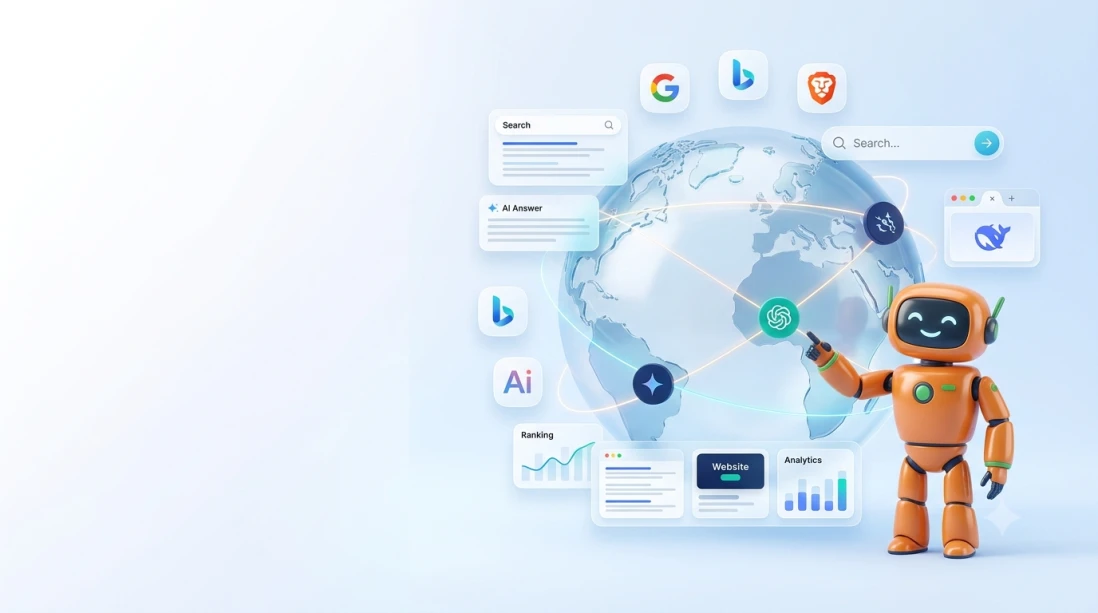
Not long ago, "search results" meant a single Google page with ten blue links. Now it's an entire ecosystem: search engines with their own index, search engines with none of their own, browsers with a built-in AI assistant, and chatbots that search on the user's behalf and hand back a finished answer. Figuring out who actually shapes the results — and who's just displaying someone else's — takes more than one browser tab.
This piece is a map of that whole territory: from Google and Bing to Baidu and Naver, from Chrome and Arc to ChatGPT Search and Perplexity. We'll cover who's borrowing whose index, which signals drive ranking in classic search versus AI answers, how to get indexed on each platform, and the ways people try to game the algorithms — and why that increasingly backfires.
1. Search Is No Longer Ten Blue Links
The chain used to be simple: user → search engine → website. Now there are several new layers between the query and the click.
First, the search engine itself can answer right away, no click required — through AI Overviews, expanded snippets, or "people also ask" boxes. Second, the browser is increasingly acting less like a window onto the internet and more like an assistant in its own right: summarizing tabs, comparing sites, answering questions directly in a side panel. Third, a separate category of AI tools like ChatGPT Search or Perplexity aren't search engines in the classic sense at all — they're answer engines that compose a response and list their sources.
The distinction matters: a search engine ranks existing pages, a browser helps process them faster, and an AI assistant synthesizes new text from several sources at once. For a site owner, that means visibility now has to be earned on three different layers simultaneously.
2. Global Leaders: Who Runs Their Own Index, and Who's Borrowing One
Google remains the biggest player, with its own index, the largest set of ranking signals, and an increasingly assertive AI Mode that replaces a growing share of clicks with direct answers. Ranking well is only half the battle if nobody clicks through once you show up — if that's the gap you're dealing with, CTR in Google — How to Increase walks through six tested ways to lift your click-through rate in classic results.
Behind Google in traffic volume sits a cluster built on Bing. This is the point people miss most often: Bing isn't just "the other Google." One and the same Bing index feeds Yahoo Search, DuckDuckGo (for its classic "blue link" results), Ecosia, and Microsoft Copilot. Yahoo, in effect, has no search technology of its own — it runs entirely on Bing, so there's no need to optimize for it separately: ranking in Bing automatically gives you visibility there too.
DuckDuckGo supplements Bing's results with its own crawler, DuckDuckBot, partner sources like Wikipedia and Wolfram Alpha, and an AI answer layer called DuckAssist. Ecosia has also historically relied on Bing and Google, but it's gradually building independence through its own index, Staan, developed jointly with Qwant as part of the European EUSP project — for now that index only covers part of the queries in a handful of European markets, while most of Ecosia's traffic is still served by Bing and Google.
3. Private and Independent Engines: Brave, Startpage, Kagi, Mojeek, Swisscows
A separate group of engines sells something other than results: freedom from being tracked. It's worth telling apart two different kinds of privacy here — "our own index" versus "someone else's index, minus the tracking."
Brave Search and Mojeek both explicitly claim full independence — each has its own crawler and its own page database, though Brave supplements it with third-party data in places. Kagi works differently: it's a paid service that blends its own indexes (Teclis, TinyGem) with anonymized queries to other systems, including Google, Brave, and Mojeek, and layers on personalization through "lenses" and the ability to manually boost or bury specific domains.
Startpage, for its part, doesn't build an index at all — it shows Google's results, but submits the query under its own name, stripping out the user's IP and profile, and deletes logs within a day. Swisscows and Qwant make a similar bet on European privacy standards; Qwant, meanwhile, is gradually moving toward a hybrid model that draws on the Bing index alongside its own developing independent index.
For SEO purposes, that means ranking in Startpage, Ecosia, or DuckDuckGo rarely takes separate effort — if a site is visible in Google and Bing, it's likely to show up there too. Brave, Mojeek, and Kagi are different: crawl access for their own bots and brand signals matter, because these platforms aren't simply relaying someone else's results.
4. Regional Champions You Can't Ignore
Global-first doesn't mean ignoring local. In several markets, Google isn't the one calling the shots.
China runs on Baidu, the country's largest search engine, with a webmaster interface that's Chinese-only and largely invite-based. South Korea belongs to Naver, which has its own indexing logic geared toward local content formats and e-commerce. Japan leans heavily on Yahoo Japan, while Czechia and parts of Eastern Europe run on Seznam, one of the creators of the IndexNow protocol, which Naver later joined as well. In Western Europe, Qwant holds a meaningful niche with French and broader European users.
The general rule across all regional leaders: local page language, local hosting, or at least clear regional signals (hreflang, local links, local contact formats) matter noticeably more here than they do in an average Google US context.
5. Browsers as a New Entry Point Into Search
Browsers used to be a neutral shell. Now they're an active participant in the search chain.
Chrome remains the most widely used browser and is increasingly building Gemini into a side panel: the assistant can summarize several tabs at once, compare sites, and — for paid subscribers — carry out actions on sites in an autonomous browsing mode. Edge has historically been the most tightly integrated with search: Copilot in Edge is built on top of the Bing index and Microsoft 365 data, making it a natural extension of ordinary Bing SEO work.
Safari remains the largest mobile and desktop gateway thanks to the Apple ecosystem and its position as the default search engine, while Firefox matters as a platform with flexible default-search choice and a privacy-minded audience. Brave combines a browser and its own independent search engine into a single privacy-focused stack with its own AI assistant, Leo. Opera One stands out by offering three AI assistants in one side panel at once — its own Aria, plus Gemini and ChatGPT — while Arc and similar products like Dia and Comet show where the whole category is heading: search, summarization, and task completion merging into one interface, bypassing the familiar results page altogether.
For sites, this means "visibility in the browser" is no longer just a position in the results — it's also the odds of being pulled into a side-panel assistant's answer that reads several sources at once.
6. AI Search and Answer Engines: Who Cites What, and Why
This is the fastest-changing part of the landscape, and each platform has its own logic for choosing sources.
Google AI Mode and AI Overviews build on Google's regular index but add an extra re-ranking layer specifically for AI answers: according to one industry study, the overwhelming majority of AI Overview responses cite at least one source from the top 20 of the regular results — meaning classic SEO remains the foundation, but on its own it no longer guarantees a citation.
ChatGPT Search relies on Bing's search infrastructure for web access, but when there's no explicit "search the web" request, the model often falls back on its training data and is more likely to cite established sources like Wikipedia and well-known brands. Perplexity works on fundamentally different logic: it runs a real-time web search for practically every query, which is why it values content freshness more than ChatGPT does and cites sources noticeably more often — including forums like Reddit.
The practical takeaway for site owners: there's no such thing as a universal "optimize for AI" strategy. A page tuned for ChatGPT citations (emphasizing recognized authorship and presence in reference sources) won't necessarily show up in a Perplexity answer, where freshness and structured user-generated content matter more — and vice versa.
7. What's Actually Changing in User Behavior
A handful of trends are setting the tone across the market at once:
- Zero-click search. More and more queries get resolved right on the results page — through AI Overviews, expanded snippets, or ready-made answer blocks — without a click to any site.
- Behavior-based personalization. Results increasingly adapt to a person's query history, location, and immediate context.
- Voice and conversational search. Queries are more often phrased as full questions rather than strings of keywords.
- Multimodal search. Searching by image, video, or a combination with text is now routine rather than experimental.
- Growing adoption of private search. Part of the audience is deliberately moving away from profiling-heavy systems toward Brave, DuckDuckGo, Startpage, and similar services.
- Direct answers instead of links. Featured snippets, "people also ask" boxes, and AI summaries capture attention before a user ever clicks through.
8. What Actually Affects Ranking
It helps to split this into two sets of signals — the classic ones, and the ones specific to AI search.
Classic signals, shared across almost every system:
- Crawlability and indexing: correct robots directives, status codes, an XML sitemap, canonical URLs, internal linking.
- Intent match: precise topical alignment, headings built around specific questions, sufficient depth on the topic.
- Authority and trust: backlinks, brand mentions, source reputation.
- Freshness — especially critical for news and trend-driven queries.
- Language and regional relevance: hreflang, localization, authority within a specific market.
- User experience: speed, mobile-friendliness, a clear page structure. On-page behavior specifically — how long people stay and whether they bounce straight back to the results — is its own lever; How to Increase User Retention on Your Website goes through what actually moves that number.
Signals specific to AI answers:
- Clear, self-contained answer blocks that are easy to extract and quote in full.
- Explicit entity signals — Schema.org markup for organizations, products, articles, and Q&A content.
- Source transparency: a named author, demonstrable expertise, consistent facts across different platforms.
- Content that addresses related and follow-up questions, not just the main query.
- Regular updates — according to some industry measurements, pages refreshed within the last few months get cited in AI answers noticeably more often than stale ones.
9. How to Get Indexed: A Practical Guide by Platform
- Google. Google Search Console, an XML sitemap, structured data, and requesting indexing selectively for new or significantly updated pages — not for routine bulk publishing.
- Bing, Yahoo, DuckDuckGo, Ecosia. Setting up Bing Webmaster Tools once is enough (you can import data directly from Google Search Console) — the same index automatically feeds Yahoo, a large share of DuckDuckGo, and Ecosia.
- Brave Search and Mojeek. What matters here is crawl access for their own bots, brand mentions, and a clear link structure — you can't rely on Google's or Bing's index to carry you.
- Baidu, Naver, Sogou. Each has its own webmaster panel, often invite-only or requiring the local-language interface; local hosting and local links noticeably improve your odds of getting indexed.
- IndexNow. Worth calling out separately: the IndexNow protocol, jointly backed by several major search engines, including Microsoft and Seznam, lets you instantly notify multiple systems at once that a page has changed, without waiting for the next scheduled crawl.
- AI platforms. There's no "submit your site" form here — visibility comes down to how crawlable the page is, how clearly it's structured as a direct answer, and how consistently the brand is mentioned across independent sources.
10. How People Try to Game the Algorithms — and Why It Increasingly Backfires
This section is analysis, not a how-to — every tactic listed here falls under one active anti-spam policy or another at the major search engines.
- Link schemes — buying, selling, or exchanging links to simulate authority.
- Expired domain abuse — buying an old domain for its link profile and repurposing it with unrelated content.
- Doorway pages — pages built purely to rank, with no real value for the user.
- Site reputation abuse (parasite SEO) — publishing third-party commercial content on an authoritative domain to exploit its trust.
- Fake reviews and forum seeding — artificially manufacturing "public opinion" about a brand.
- Scaled low-quality AI content — dozens of templated articles with no real expertise, published purely for volume.
- Manipulating structured data and snippets.
- Attempts to influence AI source selection — for example, publishing "answer-shaped" blocks or engineered comparison pages designed specifically to be extracted and cited by an algorithm.
A notable recent shift: major search engines are now openly extending their anti-spam policies to cover attempts to influence AI answers too — meaning manipulation aimed not at a classic ranking position, but at landing inside an AI model's citation, can also be treated as a violation. The short-term payoff from these tactics is almost always followed by long-term risk: demotion, deindexing, or a loss of trust with AI systems, which are increasingly cross-checking how consistent a brand's facts are across independent sources.
If you're weighing whether any of these gray-area tactics are still worth the risk, Grey Hat SEO: Effective or Risky? breaks down where the line actually sits and what tends to get caught.
11. Adapting an SEO Strategy for Both Classic and AI Search
A strategy that works on both fronts usually rests on several elements at once: technical crawlability, consistent digital PR and brand mentions on independent sites, clear entity signals through structured data, expert, attributed content, and a format that answers questions directly — with clear answer blocks rather than lengthy exposition alone. Video search deserves its own line item here — TikTok in particular runs on a recommendation logic that doesn't map cleanly onto either classic SEO or AI answer engines. If video content is part of your traffic mix, How the TikTok Algorithm Works breaks down what actually drives reach and how to get pulled into the For You feed.
A separate discipline is not mixing intents: don't try to serve a classic SEO query and a question aimed at a direct AI answer on the same page. These are different content formats, and blending the logic of one into the other tends to weaken both at once.
Search Engine Comparison: Region, Index Source, and Privacy
|
Engine |
Region / Focus |
Index Source |
Privacy |
AI Features |
|
Google Search |
Global |
Own |
Standard |
AI Mode, AI Overviews |
|
Bing |
Global, strongest in the US |
Own |
Standard |
Copilot |
|
Yahoo |
Global |
Bing index |
Standard |
Via Bing |
|
DuckDuckGo |
Global, privacy-focused |
Bing + own crawler |
High |
DuckAssist |
|
Brave Search |
Global, privacy-focused |
Own |
High |
Answer with AI |
|
Ecosia |
Global, eco-focused |
Bing/Google, partly own index (Staan) |
Medium |
Limited |
|
Startpage |
Global, privacy-focused |
Google (proxied) |
High |
None |
|
Kagi |
Global, paid |
Hybrid of own and third-party indexes |
High |
Built-in AI answers |
|
Mojeek |
Global, independent |
Own |
High |
Limited |
|
Baidu |
China |
Own |
Standard |
Own AI search |
|
Naver |
South Korea |
Own |
Standard |
Limited |
|
Qwant |
Europe |
Bing / own index (Staan, in development) |
High |
Limited |
Browser Comparison: Default Search and AI Features
|
Browser |
Default Search |
AI Assistant |
Standout Feature |
|
Chrome |
|
Gemini (side panel, Auto Browse) |
Largest market share |
|
Edge |
Bing |
Copilot |
Deep Microsoft 365 integration |
|
Safari |
Varies by market (often Google) |
Limited |
Key mobile gateway via Apple |
|
Firefox |
Configurable |
Limited |
Flexibility in choosing a default engine |
|
Brave |
Brave Search |
Leo |
Privacy as the core product |
|
Opera One |
Configurable |
Aria, Gemini, ChatGPT (all in one sidebar) |
Three AI assistants at once |
|
Arc / Dia / Comet |
Varies |
Built-in agent, search and summarization in one interface |
Blurring the line between browser and search engine |
Frequently Asked Questions
Do I need to optimize separately for Yahoo and DuckDuckGo if my site already ranks well on Bing? Usually not. Yahoo runs entirely on Bing's technology, and DuckDuckGo pulls most of its classic results from Bing — setting up Bing Webmaster Tools covers several platforms at once.
Should content be optimized separately for ChatGPT Search versus Perplexity? Yes, if either platform sends meaningful traffic to your niche. They use different logic for choosing sources: ChatGPT leans more on established reference sources, while Perplexity weighs freshness and a live web search at the moment of the query.
Can you pay for placement in an AI answer, the way people used to pay for search ads? There's no paid placement in ChatGPT, Perplexity, or Google AI Overviews responses — visibility there is earned entirely through technical accessibility, content structure, and accumulated authority.
What should I check first if a site drops out of several search engines at once? Start with indexing in Google and Bing — most other systems rely on one of these two indexes in some form, and the problem is often resolved at that level.
In Closing
Today's search landscape no longer boils down to a single results page — it's a web of indexes, browsers, and AI assistants, each deciding differently who to show the user. The winners aren't the ones who found a loophole in a particular algorithm; they're the ones who built technical accessibility, expert content, and a consistent brand presence across several independent platforms at once.
Some of the signals covered above — behavioral metrics, brand mentions across independent sources, general activity around a site — don't build themselves; they take deliberate work. IPweb automates that work: the service drives motivated traffic — real users worldwide with unique IP addresses completing paid tasks — helping a site build up exactly the signals that both classic search engines and AI systems rely on.

SEO Expert