Getting discovered as a streamer was never purely about talent. Every major platform sorts its live directory by some mix of viewer count, chat activity, and watch time — and no two platforms weigh that mix the same way. Someone who understands how Twitch's category pages actually rank channels, or why Kick cares about chat velocity, or why TikTok LIVE lives and dies on the first sixty seconds, has a real edge over a streamer who just hits "go live" and hopes. Here's what genuinely moves the needle across the platforms that matter in 2026, and where the shortcuts stop paying off.
Introduction
Why streaming platforms matter for creators and brands
A livestream does something a recorded video can't: it puts a creator in the same room as their audience in real time, chat scrolling underneath, reactions landing instantly. That immediacy builds trust faster than pre-recorded content usually can — the viewers who show up live and stick around tend to become the most loyal slice of any audience. For brands, live has quietly become where product launches, live shopping, and actual community-building happen. Not just where gaming content lives anymore.
Which platforms are included in this guide
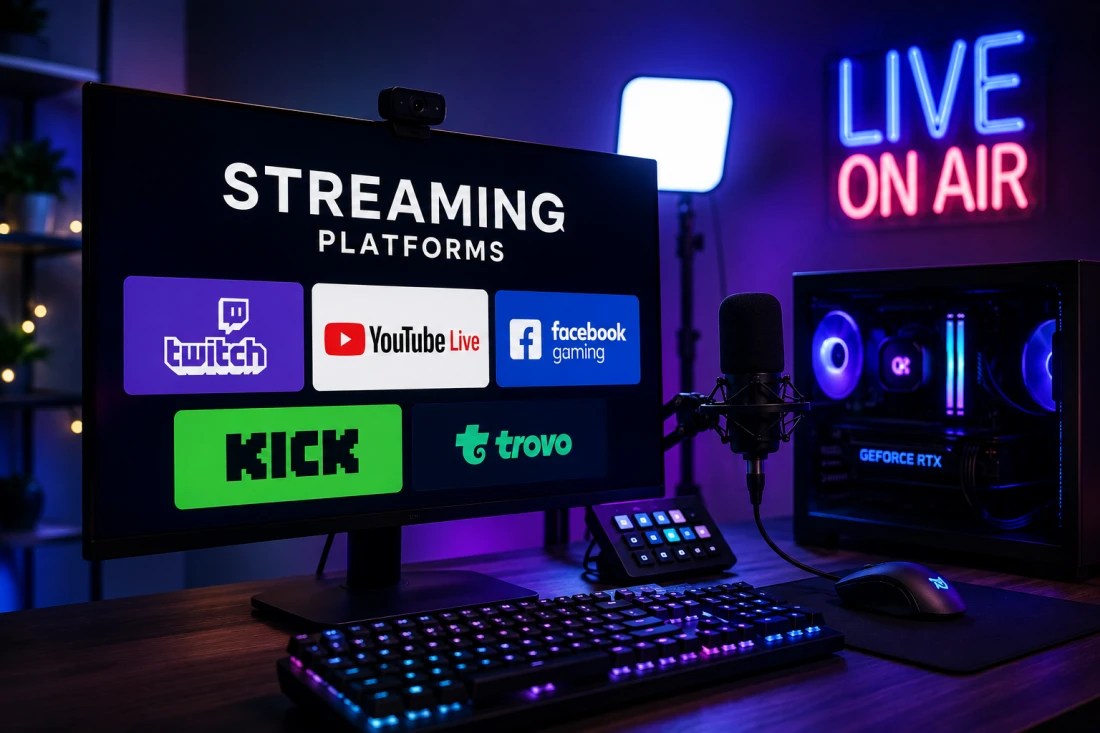
This covers Twitch, YouTube Live, Kick, and TikTok LIVE in depth, plus a handful of platforms worth knowing even if they're not the obvious first pick — Rumble, Bigo Live, Facebook Gaming. None of these are the only places to stream. They're the ones with real audiences, discovery systems that actually function, and rules clear enough to build a strategy around.
What makes Twitch different from other streaming platforms
Twitch is still the platform everyone else gets measured against, mostly because its category-page model — sorting live channels by viewer count within a specific game or topic — became the template competitors either copied outright or deliberately designed around. It's also unusually direct about enforcement. Viewbotting and follow-botting are explicitly banned, and Twitch runs specific, escalating penalties aimed squarely at faked viewer numbers — a level of bluntness that's not universal across the industry.
Where to stream
Twitch
Still the largest dedicated live-streaming platform by audience, skewing 18 to 34 and noticeably male, strongest in the US, UK, Europe, Canada, and Australia. Default home for gaming, IRL content, community-driven channels, and niche entertainment — anything that depends on a returning, habitual audience rather than one lucky viral spike.
YouTube Live
The broadest audience of any live platform, largely because it isn't purely a live platform in the first place. A stream on YouTube becomes a searchable, recommendable VOD the second it ends. That makes it the strongest option for education, tutorials, podcasts — any format where the live session is really just the first life of something that keeps earning views for months afterward.
Kick
Younger and more male-skewing than Twitch, with real strength in Turkey, the US, Latin America, the Middle East, and parts of Europe. It launched in late 2022 right after Twitch tightened its gambling restrictions, and built its early growth by poaching Twitch's biggest names and welcoming casino-adjacent content Twitch wouldn't touch. By early 2026 it had crossed 100 million users, backed by close to a billion dollars of personal investment from its founders — enough scale to make it the only credible Western alternative to Twitch, even if the audience still reads as less universal.
TikTok LIVE
Very young, mobile-first, built for spontaneous discovery rather than appointment viewing. Most viewers stumble into a stream mid-scroll rather than opening the app to watch someone specific. Strong for entertainment, live shopping, lifestyle content, anything carried by personality — weaker for long, deep sessions that need someone to sit still for an hour.
Other live streaming platforms
Rumble carries a smaller, more niche audience with a heavy lean toward commentary, political talk, and opinion content — not a fit for every creator, but genuinely useful for the specific niches that thrive there. Bigo Live skews young and mobile-heavy, built around gifting rather than subscriptions. Facebook Gaming reaches an older, broader crowd than Twitch and works for community-first or locally-focused streaming, though most creators treat it as a supplementary channel rather than home base.
How discovery works
Category browsing and live directories
On both Twitch and Kick, the category or directory page is the single most important discovery surface for a growing channel. It's where someone opens a specific game or topic looking for something to watch, and both platforms let viewers sort live channels high to low by viewer count. Getting buried on page eight of a category is functionally invisible — almost nobody scrolls that far down.
Search, recommendations, and suggested streams
Beyond category browsing, most platforms layer in a recommendation system trying to match viewers to channels based on past behavior rather than a manual search. TikTok LIVE leans hardest into this: its interest-graph model can push a brand-new creator's stream to strangers who recently engaged with similar content, which is part of why a fresh account can sometimes go visible faster there than an established one that's gone quiet.
The role of concurrent viewers, chat activity, and retention
Concurrent viewers move category-page rankings, but chat activity and retention increasingly decide what happens after that first click. Kick's 2026 discovery system explicitly rewards chat participation relative to viewer count — a stream where forty out of fifty people are actively chatting can get a stronger push than a much bigger, quieter one. TikTok has drifted the same direction: streams that hold attention and generate real interaction now beat ones that just rack up a short-lived spike in views.
Why some platforms are better for discovery than others
The honest answer: discovery gets easier the thinner the competition. Starting fresh on Twitch in 2026 means stepping into an extremely crowded field where established creators own the category pages. That exact same channel — buried on page fifteen of a Twitch category — might land on page one of the identical category on Kick, purely because fewer people are fighting for that spot.
How to promote a stream
Profile and channel setup
A channel page is often the first thing a potential viewer checks before committing to watch. A filled-out bio, consistent branding, clear info about schedule and content type — all of it builds the trust that turns a curious click into an actual "watch" click. An empty or half-finished profile undercuts even genuinely good content sitting right below it.
Titles, thumbnails, and stream metadata
A title and thumbnail are the pitch a potential viewer sees before they've watched a single second. Vague, generic titles blend straight into a category page full of near-identical listings; a specific, honest one gives someone an actual reason to click. On TikTok specifically, a custom cover image measurably raises the odds a scrolling viewer taps into a live stream instead of swiping past it.
Consistent schedules and recurring formats
A predictable schedule does more for long-term growth than almost any single tactic. Viewers who know when a favorite streamer goes live build the habit of showing up — which stabilizes viewer counts and, in turn, improves category-page placement over time. This matters even more on TikTok, where the algorithm has grown noticeably less forgiving of long gaps. Go dark for a while and it can take months to rebuild the reach a channel used to have.
Clips, VODs, and external promotion
Short clips and full VODs stretch a stream's life well past the broadcast itself — especially cross-posted elsewhere instead of left sitting in one archive. On Kick specifically, cold audiences pulled in from short-form clips on TikTok or YouTube Shorts convert into live viewers at a dramatically higher rate than anything the in-platform discovery system delivers on its own.
Community building and collabs
A genuinely active community — regulars in chat, inside jokes, a sense of continuity between streams — is what turns a channel from a place people visit once into one they return to on a schedule. Collabs and raids with similarly sized channels remain one of the most reliable ways to reach an audience already primed to enjoy that kind of content, since the recommendation comes from a trusted peer instead of a cold algorithmic suggestion.
Platform-specific strategy
Twitch
Twitch rewards consistency more than almost any single tactic could. Return-viewer behavior and steady watch time move a channel up on category pages and into recommendations in a way no single viral moment replicates. The trade-off: a genuinely mature, crowded field — more total viewers than anywhere else, but also far more creators fighting for the same slice of attention.
YouTube Live
The platform's real advantage shows up after the stream ends, not during it. A live session structured and titled like a piece of standalone content keeps earning search traffic and recommendations long after the chat has gone quiet. Streamers who treat YouTube as live-only are leaving most of its actual value on the table.
Kick
Chat velocity relative to viewer count is currently the clearest ranking signal on the platform, and niching down beats trying to compete broadly — being a top-five streamer in a narrow subcategory carries more weight than being the two-hundredth channel in something massive like Just Chatting. Kick's May 2026 crackdown, which banned 500 accounts responsible for roughly 13% of the platform's total watch hours, signaled a real shift toward rewarding authentic engagement over raw, inflated numbers.
TikTok LIVE
Success here runs on a loop between short-form video and live broadcasting — regular uploads function almost like trailers for a creator's live persona, feeding the algorithm signals about who to show a stream to. Streaming three or four times a week, even briefly, now beats occasional long sessions chasing one viral break.
Niche or emerging platforms
Rumble rewards creators whose content genuinely fits its audience — opinion, commentary, political talk — more than it rewards broad entertainment value; forcing a general gaming channel onto Rumble mostly wastes the platform's actual strength. Bigo Live and similar gifting-driven platforms favor personality-forward, highly interactive content over polished production, since the core mechanic is real-time viewer generosity, not subscription revenue.
Ranking and visibility signals
What platforms seem to reward
Across nearly every platform here, the same pattern holds: real engagement — chat messages, reactions, return visits — counts for more than raw viewer numbers alone, and platforms have gotten noticeably better at telling the two apart.
The importance of live activity and chat velocity
A quiet stream with two hundred silent viewers now underperforms a much smaller, actively chatting one on platforms that weigh engagement this way. Kick's discovery system will favor eighty viewers producing five chat messages a minute over a passive crowd more than twice that size.
The role of audience consistency and watch time
Consistency compounds in a way single spikes never do. A streamer showing up on the same schedule week after week builds a base of returning viewers, and their habitual watch time becomes the strongest signal a platform has that the channel is worth recommending to someone new.
Why replay value matters on some platforms more than others
On YouTube, a stream's life genuinely starts after it ends — the VOD keeps pulling in views, comments, and search traffic indefinitely. On Twitch, replay value matters far less; most of a channel's discovery still happens live, through category pages and broadcast-tied recommendations. Which is part of why Twitch creators lean so hard on being live and visible at consistent times rather than banking on catalog traffic to carry them.
Manipulation and abuse
Viewbotting and artificial concurrency inflation
Buying fake concurrent viewers to push a channel higher on a category page is probably the single most common manipulation tactic across live platforms — and it's easy to see why. Category rankings sort by viewer count, so inflating that number buys placement directly. Twitch's own leadership has acknowledged that viewbotting's actual impact on category-page discovery turns out to be pretty small in practice, since the platform runs both high-to-low and "recommended" sorting, and the second one isn't easily gamed by raw numbers alone.
Fake follows, fake chat, and engagement rings
Beyond viewer counts, fake followers and bot-driven chat try to manufacture the same signals platforms now weigh more heavily than raw viewership. A channel with an active-looking chat reads as more worth watching — exactly why services selling fake engagement have expanded well past just inflating viewer numbers.
Coordinated raids and manipulated category placement
Coordinated groups deliberately misdeclaring a stream's category, or staging fake raids to simulate organic traffic, distort the same directory pages real viewers rely on. Platforms increasingly treat a category mismatch as a trust signal that drags down a channel's standing even outside the specific stream where it happened.
Spam promotion and misleading metadata
Titles and tags written to bait clicks instead of describe the actual stream — a gaming tag on something that's really just chatting, a title promising content that never shows up — tend to backfire once a platform's systems catch the mismatch. It trains the algorithm to stop trusting a channel's metadata altogether.
Cross-platform traffic manipulation
Some manipulation happens entirely outside the streaming platform — services promising inflated follower counts or fake cross-platform referral traffic to make a channel look more established than it is. Since most platforms treat sudden, unnatural spikes as one of the strongest fraud signals they have, these campaigns tend to draw exactly the scrutiny they were built to avoid.
Enforcement and penalties
Stream demotion and reduced discoverability
The mildest, most common response is a quiet drop in category-page ranking and recommendation eligibility, applied with no public notice at all. A channel simply stops showing up where it used to, with no obvious explanation attached.
Removal from recommendations or category surfaces
Confirmed manipulation gets a channel pulled from exactly the surfaces those campaigns are usually built to reach — category pages sorted by viewer count, homepage recommendations, algorithmic "for you" feeds.
Monetization limits and payout holds
Confirmed manipulation can freeze or reduce monetization — subscriptions, ad revenue, partner payouts — even when the broadcast content itself breaks no separate rule. On Kick, gambling-category creators lost eligibility for hourly partner-program pay as part of a broader 2026 policy shift, a reminder that monetization rules can change independent of anything a streamer personally did.
Suspension, bans, and partner program loss
Twitch took a notably different approach to viewbotting penalties starting May 2026. Instead of an immediate ban, confirmed offenders get their displayed concurrent viewer count capped — based on the channel's own pre-manipulation traffic history — for a fixed period that escalates with repeat violations. Kick went blunter the same month, banning 500 accounts responsible for an estimated 79 million fake watch hours, roughly 13% of the platform's total, in a single coordinated sweep.
Permanent trust or account restrictions
Even short of a formal ban, a confirmed manipulation history tends to follow a channel forward. Platforms increasingly track past violations when weighing future eligibility for partner programs, monetization features, and promotional placement — meaning one serious infraction can shape a channel's standing long after the original penalty technically ends.
How to choose a platform
Best platform for gaming
Twitch is still the default given its scale and established culture, though Kick has become a genuinely viable alternative — particularly for creators targeting Latin America, Turkey, or the Middle East, where Kick's regional communities and payout structure now compete directly with Twitch's reach.
Best platform for education and tutorials
YouTube Live wins here, purely because of what happens after the broadcast ends. A tutorial that becomes a searchable, evergreen VOD keeps delivering value to new viewers long after the live audience has logged off.
Best platform for community-first content
Twitch and Facebook Gaming both reward channels built around a returning, habitual audience rather than one-off virality — Twitch through its category and chat culture, Facebook through a broader, older, more locally-rooted user base.
Best platform for long-term discovery
TikTok LIVE currently runs the most aggressive discovery engine for brand-new creators, thanks to an interest-graph system that can surface a stream to strangers based on recent viewing behavior rather than requiring an existing following. That same discovery advantage rewards frequent, consistent streaming far more than one strong session.
Conclusion
Best platforms to start with
For most streamers, a sensible starting combination pairs one platform with broad, established discovery — Twitch for gaming and community content, YouTube Live for anything with lasting educational or long-form value — with a faster-growing alternative like Kick or TikTok LIVE, where competition for visibility is currently thinner.
The safest growth strategy
Durable growth on every platform here runs on the same handful of fundamentals: a consistent schedule, real engagement with chat, honest titles and category tags, and a genuine community that returns because it wants to — not because a number got manufactured. Buying viewers or followers might nudge a ranking briefly, but detection got sharply better through 2026. Twitch's viewer-count cap and Kick's mass ban of botted accounts both show platforms actively rebuilding their discovery systems around catching exactly this kind of manipulation.
What to avoid
Skip anything that manufactures numbers instead of earning them — purchased viewers, fake chat activity, coordinated raids built to simulate organic traffic, misleading category tags meant to game a directory page. These tactics increasingly get caught, and the fallout — from a quiet viewer-count cap to a full ban and lost partner status — tends to cost a channel far more visibility than it ever bought.

Internet Marketer