Why without promotion on Yandex Market sales quickly hit a ceiling
Yandex Market today is one of the key marketplaces in Russia, and competition there is no longer like on a “classifieds board from the 2000s”.
According to e-commerce market research, 81% of all online orders in the country go through four major marketplaces, including Yandex Market. The platform itself already has about 18.5 million active buyers and more than 78,000 sellers.
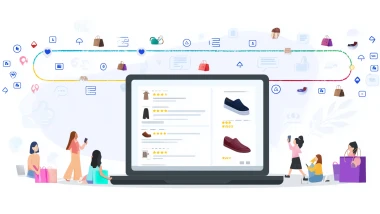
The logic is simple: there are many customers, but even more offers. If a product card does not appear in search results and recommendations, the buyer simply will not see it.
A typical seller’s situation: they honestly filled in the specifications, uploaded decent photos, set a competitive price, turned on minimal ads — and still the product hangs somewhere at the bottom of the list, impressions are weak, and sales “jump” from one promotion to another.
The reason is that Yandex Market’s internal SEO relies not only on price and how well the card is filled out, but also on behavioral factors: clicks, viewing depth, adding to favorites, adding to cart, transitions to other products, and so on.
And this is where it gets interesting: simply pouring more budget into ads is not always the solution. The algorithm looks at how real people interact with a specific product, and the more “alive” the activity around it is, the more willingly the platform shows this product higher and more often.
That is why organic promotion based on actions of real users becomes a critically important tool, not something done “just for show”.
How IPweb promotes products on Yandex Market through organic actions
IPweb works not through bots, but through organic actions of real people. The idea is that you configure activity scenarios, and real users go to Yandex Market and perform the actions that algorithms like: view the product card, browse photos, read the description, add the item to favorites or to the cart, move to other products of the seller, ask a question, and so on.
In very simple terms, it looks like this:
- You choose a product or a group of products that need to be promoted on Yandex Market.
- In IPweb you set task parameters:
- number of product card views;
- photo clicks and gallery browsing;
- adding to favorites and to the cart;
- transitions to other products in your store;
- time on page, viewing depth;
- complex tasks (for example: find by query, open several similar products, choose yours and add it to the cart).
The service distributes tasks among real users who go to the Market and perform these actions without sharp spikes or suspicious uniformity.
For the marketplace algorithms, this looks like honest, live interest in the product. The card gets higher CTR from search, average viewing time grows, and the share of products that people save and add to the cart increases. All of this directly affects positions in search results and inclusion in recommendations.
According to marketplace specialists, even a 20–30% increase in behavioral activity can noticeably raise impressions and clicks on product cards, and then orders follow, especially in competitive categories like electronics, clothing, and children’s goods.
Yes, the exact numbers differ for each seller, but the overall trend is clear: organic strengthening of behavioral factors often gives a greater long-term effect than a one-time purchase of paid impressions.
When to launch promotion on Yandex Market via IPweb and what you get in the end
Promoting products on Yandex Market through IPweb is especially useful when:
- you are launching a new brand or store and need to “warm up” product cards so they start being seen at all;
- the product is in tough competition where dozens of almost identical offers exist and the winner is the one with higher rating and activity;
- positions dropped after a season or a promotion and you need to carefully return the card to the top for queries;
- you are testing different prices, titles, and photos and want to gather audience reaction statistics faster;
- ads are already running, but clicks and orders are clearly fewer than they could be for that bid.
What organic promotion via IPweb gives you in the end:
- growth of product card positions in Yandex Market search for key queries;
- increase in impressions and target visits without aggressive traffic buying;
- strengthening of behavioral factors (views, favorites, cart, photo clicks);
- a more “alive” store profile thanks to transitions to your other products;
- reduced dependence on short-term promotions and paid boosts;
- a safe promotion format without bots and risky schemes.
In essence, IPweb helps you speak to the algorithm in its own language — the language of behavioral metrics. You are not inflating empty numbers, but modeling the actions that successful sellers already have: interest, viewing, saving, adding to cart, and purchase.
And this is no longer magic of a “secret trick”, but a clear, systematic approach to organic promotion on Yandex Market, where you control not only the budget, but also the quality of activity around your product cards.