Incentivized Traffic vs. Organic Traffic
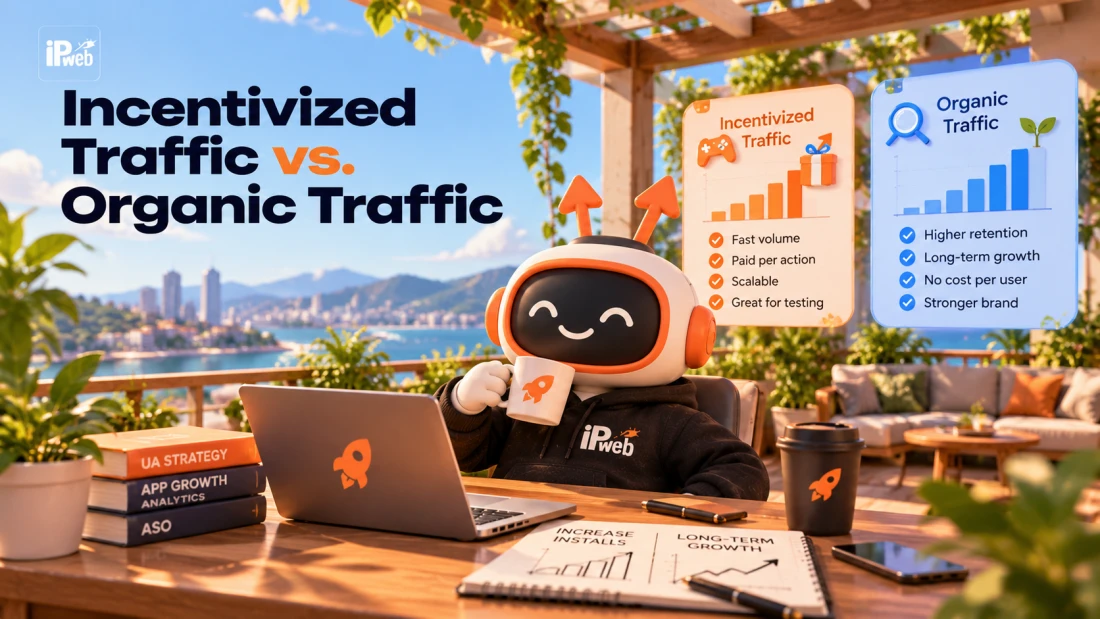
Organic traffic has a spotless reputation among app marketers, and incentivized traffic has a doubtful one. Both reputations are partly deserved and partly out of date. Organic users are usually more loyal, but not always. Incentivized installs can hurt an app, but they can also help it rank. Below is a short comparison of the two channels, followed by five beliefs about them that don’t hold up against the data.
The Short Comparison
|
Organic traffic |
Incentivized traffic |
|
|
Where users come from |
Store search, charts, word of mouth, your site |
Offerwalls, rewards apps, task platforms |
|
Cost |
No cost per user, but ASO takes ongoing work |
Paid per install or per in-app event |
|
Speed and volume |
Slow, hard to scale on demand |
Fast, set by budget and geo |
|
Retention |
Usually higher |
Depends on what you reward |
Myth 1: Organic Users Are Always Better
On average, organic users do retain better. Benchmark roundups for 2026 put organic retention at roughly 1.5 to 2 times that of paid installs. But averages hide a lot. Some analyses of mobile games have found paid and organic retention to be almost identical, and the gap changes from category to category.
On the incentivized side, much depends on what the user is rewarded for. A reward for the install brings people who collect it and leave. A reward for reaching level 15 or finishing a first week of workouts brings people who have actually used the product. That kind of cohort can come much closer to organic numbers than the channel’s reputation suggests. Compare cohorts inside your own app before you write off a channel.
Myth 2: Incentivized Installs Take Away From Organic Ones
The worry is that you’re paying for users who would have found you anyway. The evidence points the other way. Researchers who analyzed a large-scale ad spend shutoff at a US mobile game developer found that paid advertising increased organic installs rather than cannibalizing them. The mechanism was store rankings: more installs pushed the app up the charts, and higher positions brought in more organic users.
A 2025 analysis by NP Digital of six months of campaign data showed the same thing. Every spike in paid installs was followed by a second, smaller spike in organic ones, and organic installs stayed flat in periods without paid campaigns.
Myth 3: More Installs Always Mean Higher Rankings
Download velocity is a ranking signal, but not the only one, and stores pay increasing attention to what happens after the install. Google is widely reported to have shifted its rankings toward post-install engagement, so apps whose install spikes are followed by mass uninstalls tend to lose position.
That changes the math on cheap install-only campaigns. Thousands of users who open the app once can do more damage than good. If you’re using incentivized traffic to support rankings, reward an action that shows real use, and check whether your organic installs hold steady after the campaign ends. If they drop back as soon as spend stops, you were renting your position rather than earning it.
Myth 4: Organic Traffic Is Free of Fraud
Most fraud checks focus on paid channels, because that’s where the money visibly goes. Fraudsters have adapted. AppsFlyer’s State of Fraud for Marketers 2026, based on more than 106 billion installs, found that organic traffic now accounts for 52% of all fraudulent installs, more than any other channel.
In practice, an unexplained jump in organic installs during an incentivized campaign isn’t automatically a halo effect. Before you count it as a win, look at the cohort’s retention, device patterns, and IP clusters. Real organic users behave like real users, and fake ones usually don’t last a week.
Myth 5: Incentivized Traffic Breaks App Store Rules
Not as such. What the stores prohibit is manipulation. Google’s User Ratings, Reviews, and Installs policy bans inflating ratings, reviews, or install counts through incentives, and Google has said it filters incentivized installs whose only purpose is improving an app’s placement. Apple’s App Store Review Guidelines allow apps to reward actions inside the app, while ruling out rewards for ratings, reviews, or downloads of other apps.
The line runs between acquiring real users who get a reward for using your product, which is allowed, and buying installs or reviews to game the charts, which isn’t. Paying for store ratings is never acceptable, whichever channel you use.
A Worked Example: Launching a Habit Tracker
Here’s how this plays out for a hypothetical habit-tracking app launching in the US. The numbers are illustrative, but the pattern is typical.
Before launch, the team spends two weeks on the store listing: clear screenshots, a subtitle built around “habit tracker,” and a short preview video. In the first month without any campaigns, the app gets about 40 organic installs a day and ranks around 60th for its main keyword.
For the incentivized campaign, the team rejects install-only rewards. Users earn a reward for completing onboarding and logging a habit on three separate days. That rules out people who’d install, collect, and leave. They run 300 completed tasks a day for three weeks.
Then they check four things.
Cohort retention. Incentivized users who completed the three-day task retain at D30 at about 70% of the organic rate. That’s lower, but far better than the near-zero D30 an install-only campaign would have produced. Because the cohorts are tracked separately, the organic benchmark stays clean.
Rankings. The app moves from around 60th to the low 20s for “habit tracker” by the end of week two. Since users had to keep using the app to earn the reward, engagement holds up and the position doesn’t collapse after the spike.
Organic installs. Organic installs rise to about 90 a day during the campaign. Three weeks after it ends, they settle at around 70 a day, still well above the 40-a-day baseline. That residual lift is the number the team cares about. The peak during the campaign mixes real halo effect with noise. What remains after spend stops is closer to the real result.
Fraud. Part of the early organic jump comes from a small cluster of installs sharing a few IP ranges, with near-zero sessions after day one. The team excludes them before calculating uplift. Without that check, the campaign would have looked about 15% better than it really was.
The decision: run shorter campaigns of the same design before major updates, rather than spending continuously, and put the saved budget into localized listings for the next market.
Putting Both Channels to Work
The choice between incentivized and organic traffic is mostly a question of timing. Organic is the goal: users who find you on their own, cost nothing per install, and stay. Incentivized traffic helps when organic can’t carry you yet, at launch or in a new market, and when you need real usage data quickly. Keep your store listing strong so every visitor converts, reward actions rather than installs, track incentivized users as their own cohort, and judge the result by whether organic growth holds after the campaign ends.
Just launched and need your first real users? IPweb connects you with English-speaking users who complete the tasks you set, from visiting your landing page to finishing registration, so your app starts collecting genuine usage data from the first week.

Internet Marketer